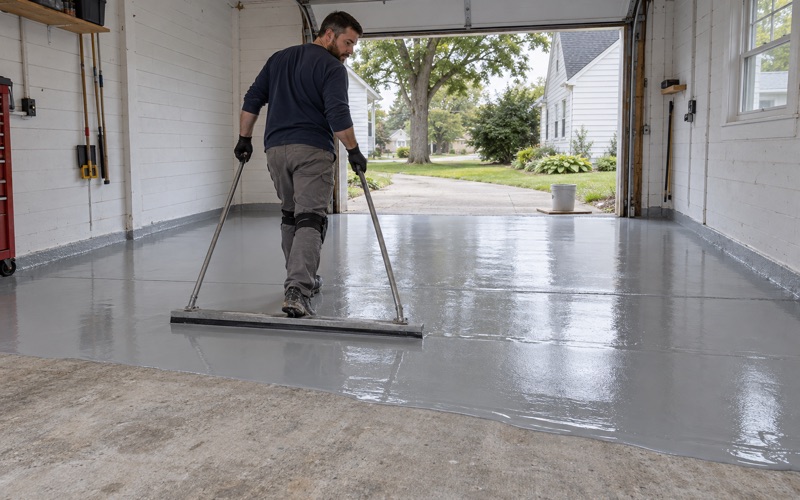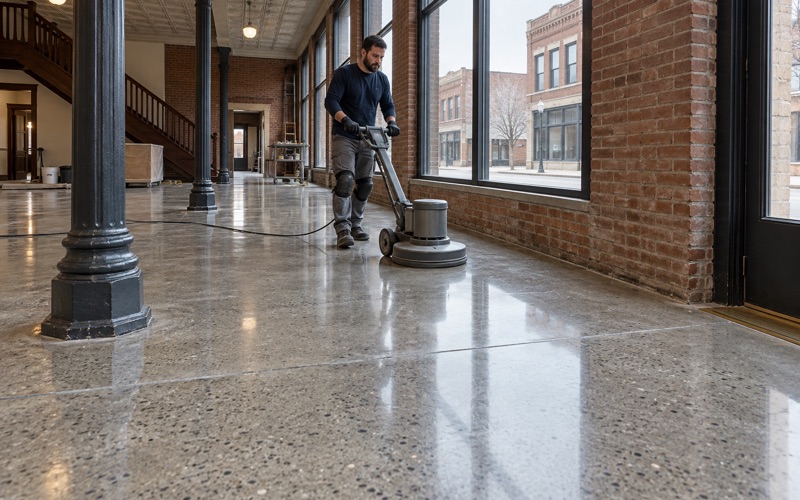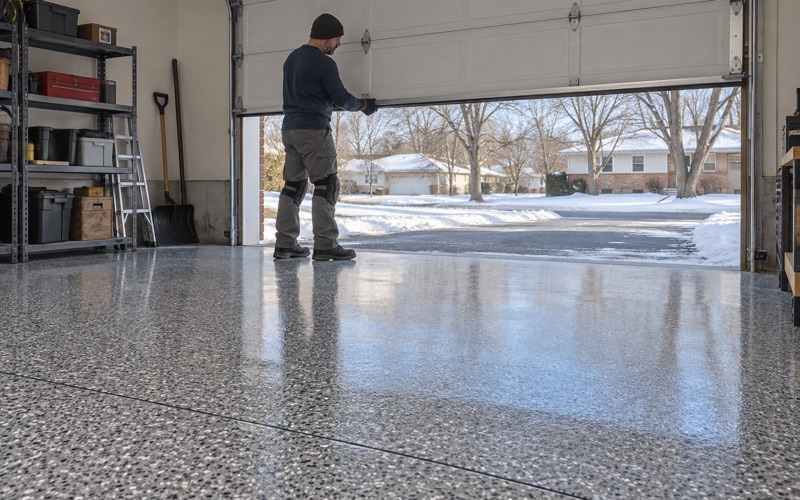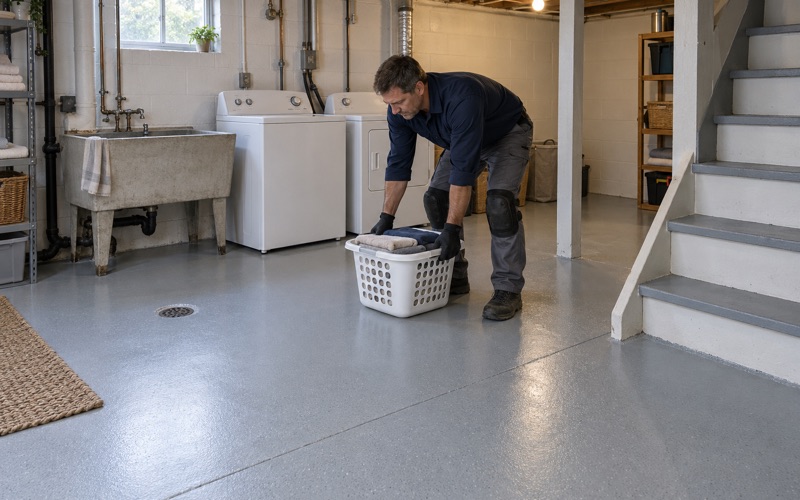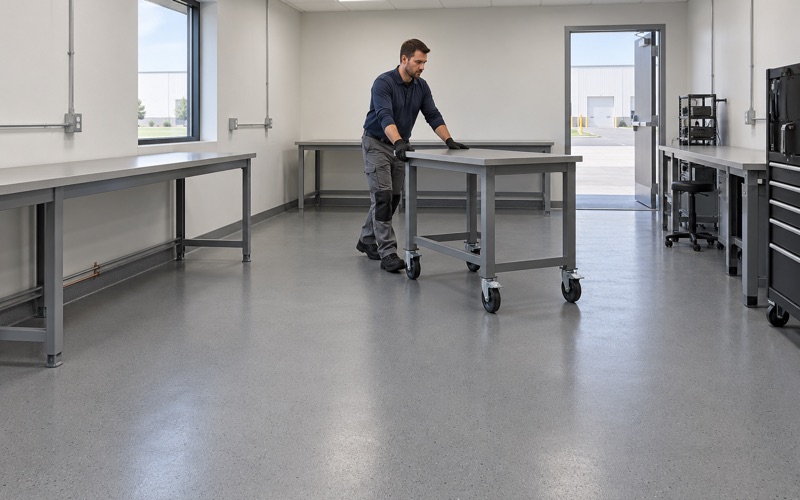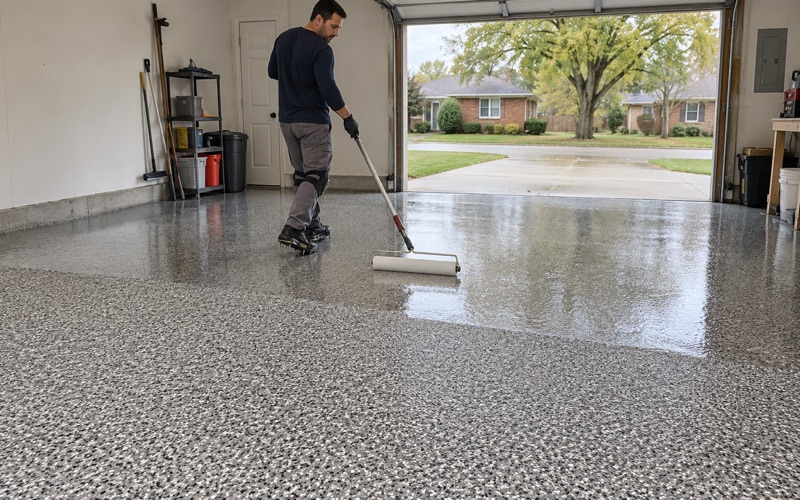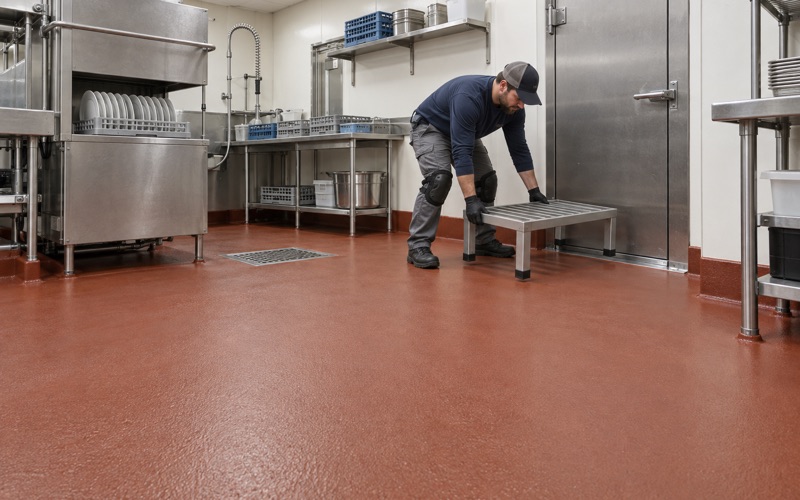
Moline Epoxy Flooring has spent 20+ years on epoxy flooring in Bettendorf and across the Quad Cities, and many of the floors we are asked about here sit under houses that are only a few years old. A newer garage slab looks clean and smooth, which is exactly why owners assume it is ready for a coat. The question we start with is not how old the concrete is, but what was put on its surface when it was finished.
That answer decides how the slab gets opened, how long prep takes, and whether a coating will stay put through its first winter of brine and rock salt. We settle it on site before we price anything. A film nobody can see is still a film, and a coating bonded to it comes off along with it.
Our crews come from Moline, Illinois, and every quote names the Iowa side by its own cities, because the rules change at the river. In Bettendorf there is no state VOC limit on the person applying a floor coating, so a low-odor product is a comfort and re-entry choice for your household, never something we sell as a legal requirement.
A Growing City Pours a Lot of New Garage Floors
About 100 Single-Family Homes a Year
Bettendorf’s finance director, Jason Schadt, told KWQC in January 2026 that the city is adding about 100 single-family homes a year, and that population has grown more than 17 percent since the 2010 census. Davenport grew 2 percent over the same stretch. For an epoxy contractor, that pace means a steady supply of garages whose concrete has never carried a coating.
The Census housing counts point the same way. Of 17,042 housing units in the city, 3,003 were built in 2010 or later, about 17.6 percent of the stock. Owners occupy 75.0 percent of occupied homes, and detached houses make up 69.1 percent of all units, so a large share of those newer slabs sit under an owner’s own garage door.
Forest Grove and the Sports Complex Corridor
KWQC’s reporting tied most of a decade’s 48 percent rise in taxable value to development near TBK Bank Sports Complex, and described Forest Grove as booming with new businesses and high-end homes. The complex on Competition Drive draws about 750,000 visitors a year, which makes it the easiest landmark for placing that growth on a map.
We use it as a landmark and nothing more. We have no relationship with the complex, the city, or any builder or developer in the corridor. A garage in Forest Grove gets the same surface check as a slab anywhere else in town, and the answer comes from that floor rather than from the neighborhood it sits in.
North of I-80 and What Comes Next
The city has broken ground on a $10.3 million project north of I-80 near the complex that will open 1,900 more acres, out of about 5,000 acres counted as developable. A MercyOne hospital, a Quad-City Bank and Trust headquarters and an ORA orthopedic facility have been announced and are still coming, not open.
For floors, the takeaway is simple. The share of Bettendorf garages poured in recent years is likely to keep climbing, which turns the surface question on this page into a practical one for a lot of owners rather than a corner case. It is worth asking before the first coat, not after the first peel.
Looking for epoxy-flooring closer to East Moline? See East Moline Epoxy-Flooring.
What May Have Been Sprayed on the Concrete
Curing and Sealing Compounds
Fresh concrete has to hold its water to gain strength, and one common way to help it is a curing compound sprayed or rolled onto the surface after finishing. Some products are cure-and-seal combinations meant to stay on as a protective film. Either way, the result is a layer on top of the slab that was put there on purpose and was never meant to be painted over.
We have not researched what any Bettendorf builder uses, and we do not assume a given house was treated. Some slabs carry a film and some do not. That is a question for the specific garage in front of us, and it gets answered by looking and testing, not by guessing from a street name or a closing date.
A Film Does Not Wear Off With Age
The usual instinct is to ask how old a slab is, but for this problem age mostly misses the point. A film-forming curing or sealing compound acts as a bond breaker on a one-year-old slab and a ten-year-old one alike. A coating rolled over it is bonded to the film, not to the concrete underneath.
Tires can wear a sealer thin in the wheel paths while leaving it intact along the walls and under shelving. That patchy condition can be worse than an even coat, because a coating may seem to hold in one area and lift in another. We check across the whole floor, not just the middle where the car parks.
What the Coating Makers Write Down
The manufacturers spell this out in their own instructions. Rust-Oleum’s EpoxyShield technical data sheet says the product is for floors “free of curing agents and sealers,” and that on a sealed floor “the sealer will have to be removed by grinding or shot blasting.” That is a garage-floor product talking about garage floors.
Sika’s MB data sheet is just as direct: paint, wax, “curing and sealing compounds” and laitance “must be mechanically removed.” We have no relationship with either company. We quote their sheets because they show the rule comes from the people who make the coatings, not from one contractor’s preference.
Why the Makers Say Grind It, Not Etch It
Acid Etching Cannot Clear a Film
Acid etching is still the prep step in many retail garage kits, and on bare, open concrete it at least reacts with the surface. On a treated slab, a curing compound or sealer keeps the acid from reaching much of the concrete at all. The film stays, and so does the bond problem it causes.
Sika’s MB sheet puts it plainly: “Acid and chemical etching are NOT acceptable.” Acid also leaves residue and water in the slab that have to be rinsed out and dried, which adds risk without fixing the surface. We do not acid etch any floor, new or old, in Bettendorf or anywhere else.
Diamond Grinding and Shot Blasting
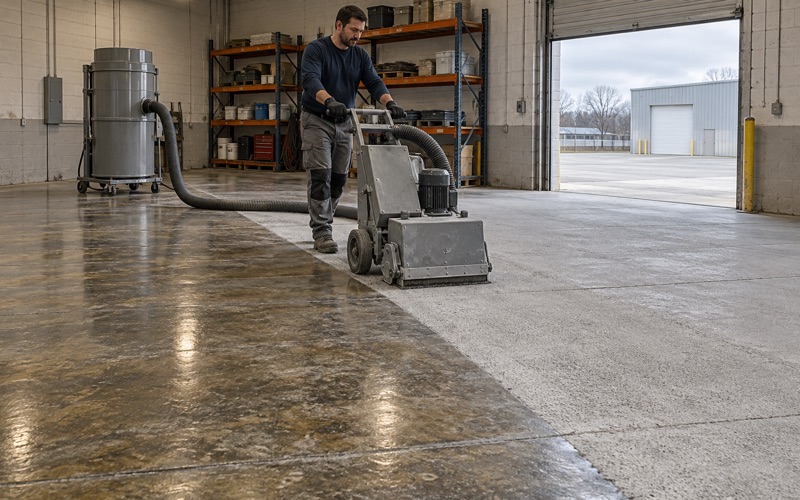
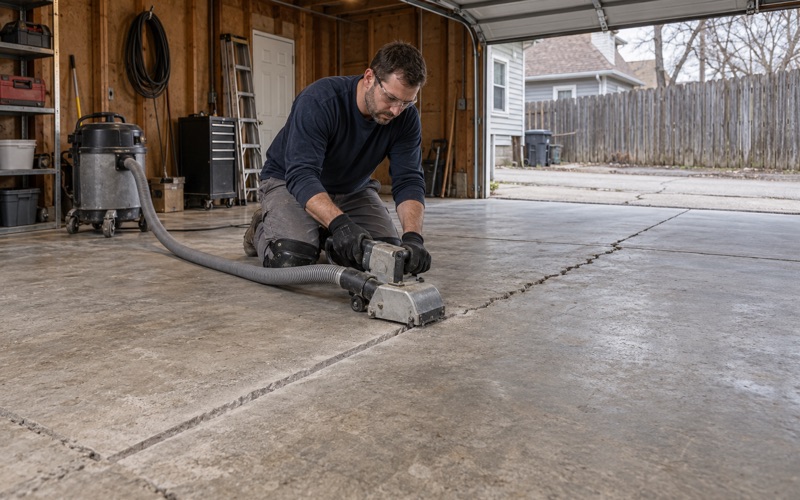
Every slab we coat is opened mechanically. A diamond grinder cuts through a film and the weak top paste beneath it, while a shot blaster throws steel shot at the surface to strip it and leave a texture. Which one we bring depends on the floor, the film and how the room works around walls, steps and drains.
Grinding dust is captured at the machine with a vacuum, not hosed toward the floor drain or out the door toward a storm inlet. On a new lot that matters, because the driveway and gutter in front of the house carry whatever is rinsed onto them, and slurry from a garage floor has no business going there.
The Profile a Coating Needs
Removing the film is half the job; the other half is giving the coating something to grip. Concrete surface profile is graded on the ICRI CSP scale, and Sika’s MB sheet calls for CSP 3-4. A smooth, troweled new slab sits below that, which is one more reason a fresh-looking floor still needs real prep.
We check the profile after grinding or blasting and before any primer goes down. If one area came up smoother than the rest, it gets another pass. A coating will find the weakest bond on the floor, and we would rather find it first with a machine than later with a customer’s car.
Checking a New Slab Before It Gets a Coat
Start With the Paperwork and a Water Drop
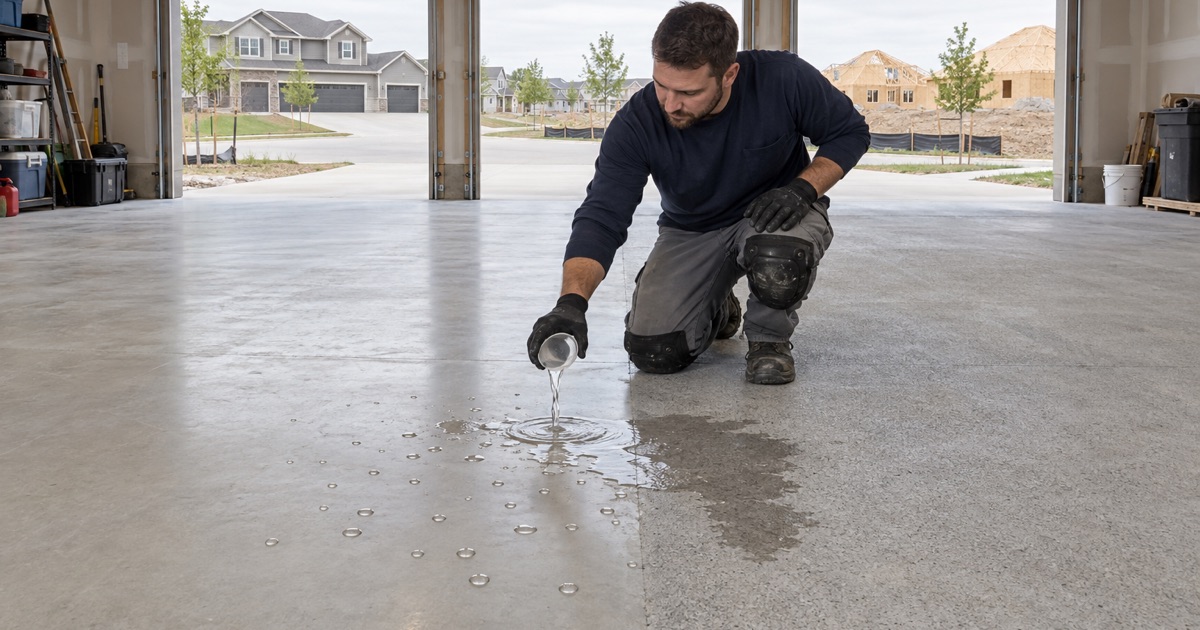
If you have the builder’s closing documents or finish schedule, they may name what went on the garage floor, and that is worth reading before we visit. Many owners do not have it, which is fine. A few drops of water will often bead on a sealed surface and darken bare concrete as they soak in.
We repeat that check in several spots, including near the walls, and treat beading anywhere as a reason to plan for full removal. A water drop is a screening step, not proof. On a floor where results are mixed, we grind a small test area and look at what comes up before writing the scope.
Moisture Still Goes on the Written Scope
A clean surface does not settle the moisture question. Every garage and basement quote we write includes a moisture test before the price is final, using the method that fits the slab, from an ASTM D4263 plastic sheet test to ASTM F2170 in-situ relative humidity probes.
We also explain what a coating warranty leaves out before the job is sold, and moisture vapor transmission is the first exclusion we name. A floor coating is never sold as waterproofing or radon work, and we put that in writing so nobody is surprised later.
A Proposal You Can Hold Up Against the Floor
The proposal names the product line, the number of coats and the finished thickness, so the finished floor can be checked against the quote. Cracks, spalls and joint damage are mapped first, and if a slab needs repair before it should be coated, we say so instead of coating over it.
Garage systems are chosen for the brine and rock salt that ride in on tires all winter, often a 100% solids epoxy base under a polyaspartic topcoat with a vinyl flake broadcast. Slip resistance is specified by the broadcast and topcoat we use, not promised as a slogan.
Timing the Cure in an Iowa Garage
Cure schedules follow slab temperature and the dew point spread at the slab surface, not the calendar. A house finished in late fall has an unheated garage heading into a Quad Cities winter, and we will tell an owner in that spot to wait for better conditions rather than coat a cold slab.
Commercial kitchens in town follow a different path. Food-service floors answer to the Scott County Health Department, working under contract with Iowa DIAL, and we plan coved bases and a wet-area texture around that inspection from the start rather than adding them at the end.
- 20+ Years on Concrete Floors
- Moisture Tested Before Pricing
- Diamond Ground, Never Acid Etched