Moline Epoxy Flooring brings more than 20 years of slab preparation and resin work to epoxy flooring in Camanche, Iowa, and much of what we are asked about on this side of the river sits below grade. A basement room that has been closed for a while raises a different question from a garage or a shop: not which color of flake, but whether the concrete underneath is ready to hold a coating at all.
We answer that question in a fixed order. Moisture comes first, then the choice of surface, then the coating, and a written moisture test sits inside the scope before any price is final. When a slab needs repair, or simply should not be coated yet, we say so before anything is sold.
This page walks through that order for a basement being reopened to the public or to a household, using federal mold guidance and the plain limits of what a resin floor can do. It also explains why we prefer a hard floor to carpet on concrete that touches the ground.
A Library in a River House, and a Basement That Was Sealed Off
How the Camanche Public Library started
The Camanche Public Library began in 1965, when a local family sold their home to the city, and local coverage has described it as a historic home on the Mississippi River. A house that becomes a public building inherits a basement built for a family rather than for programs and visitors. That gap is common in older civic buildings, and it is the setting for this page.
Camanche sits in Clinton County on the Mississippi River and counted 4,570 residents at the 2020 census. Its housing is mostly owner-occupied and detached, and 46.5 percent of units date from the 1960s and 1970s, so older slabs are part of the local stock. We read those slabs with the same care whether the room is public or private.
What the city has said about the basement
Before the vote in November 2025, the city said that as the library’s condition worsened, the basement was sealed off, and its space and services went with it. The director described cramming programs into a tiny space upstairs. No cause for closing the basement was reported, and we do not guess at one.
That last point matters to us. We have no role with the library, its trustees or the City of Camanche, and we have not bid any of the work. What we can offer is the general sequence any below-grade room should follow before it reopens, which is what the rest of this page covers.
Repairs after a failed bond
The 4.2 million dollar library bond failed with 66 percent of voters saying no, short of the 60 percent approval it needed. The city’s 2025 capital plan still lists necessary HVAC, roofing, bathroom and basement improvements. In August 2026 the city agreed to fund up to 525,000 dollars in library repairs.
The repair list itself has not been published in anything we have read, so we cannot say what that money covers. Still, HVAC and a basement on the same list is a reminder that air handling and floors work together below grade. A room’s humidity is set by its mechanical systems long before anyone chooses a finish.
Looking for epoxy-flooring closer to Clinton? See Epoxy-Flooring in Clinton.
Moisture First, Then the Question of Carpet
Controlling moisture is the starting point
EPA’s Mold in Schools fact sheet, part of its Indoor Air Quality Tools for Schools material, puts it plainly: controlling moisture is the key to managing mold. The guidance is written for school buildings, but its logic fits any public room below grade. Fix the water source and the air before talking about surfaces.
The same fact sheet asks for damp or wet materials to be cleaned and dried within 24-48 hours after a leak or spill. It also names painting and carpet cleaning as maintenance activities that add moisture to a building. Even routine upkeep, in other words, feeds the problem when a room has no way to dry out.
Keeping indoor humidity in range
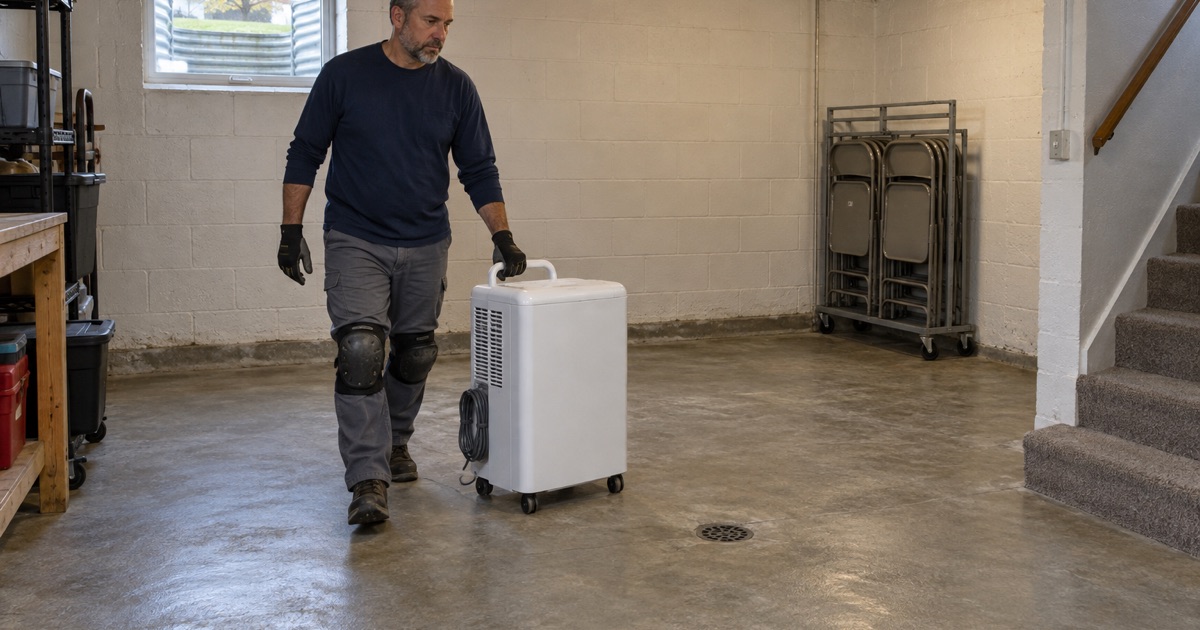
EPA recommends keeping indoor relative humidity between 30 and 50 percent. In a basement that usually means dehumidifiers and air movement sized to the room, which is HVAC work rather than floor work. We ask what the plan is for humidity before we price a coating, because a floor installed into a damp room is fighting the room.
Humidity also governs the installation itself. We schedule cure by slab temperature and the dew point spread at the slab surface, not by the calendar, since a slab near the dew point collects condensation that can leave amine blush on fresh epoxy. A room that holds steady humidity gives the coating a fair start.
Why EPA says to avoid carpet on ground-contact concrete
The fact sheet lists carpet among the places mold grows, and it says to avoid installing carpet on concrete floors in contact with the ground and subject to frequent condensation. It also says porous materials such as carpet should be removed and replaced once they become moldy. A basement slab is ground-contact concrete by its nature.
Carpet over a cool slab holds moisture where nobody can see it, and the pad keeps it pressed against the concrete. When condensation forms on that slab, the carpet becomes the wet material the guidance warns about. That is the reasoning behind a hard floor in a reopened below-grade room, and it is not a matter of style.
A Hard, Scrubbable Floor, and What a Coating Cannot Do
A surface that can be cleaned and dried
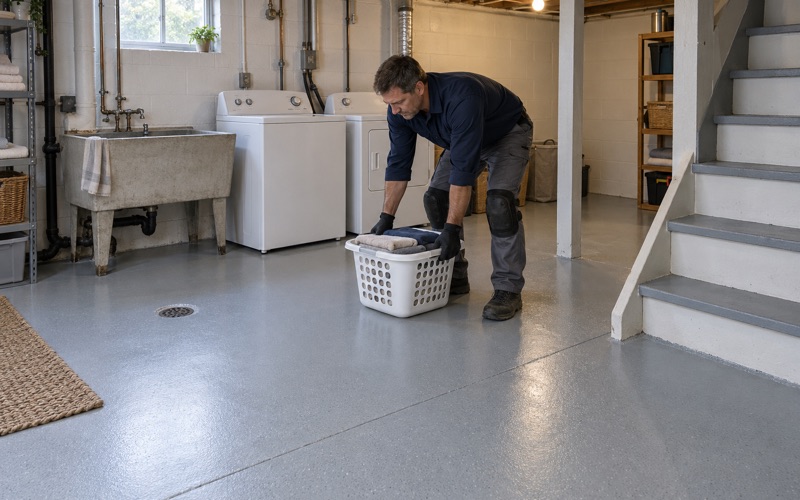
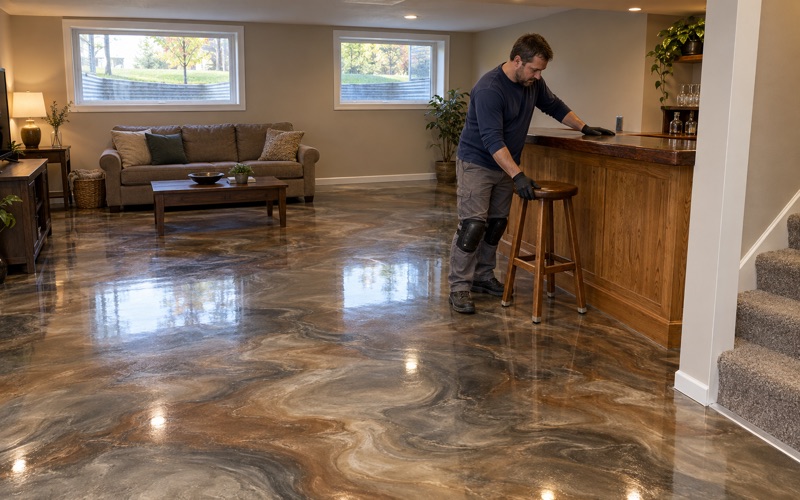
EPA’s guidance says to scrub mold off hard surfaces with water and detergent and dry them completely. A resin floor gives a basement that kind of surface: no fibers, no pad, nothing that wicks. Spills can be wiped up and the floor dried the same day.
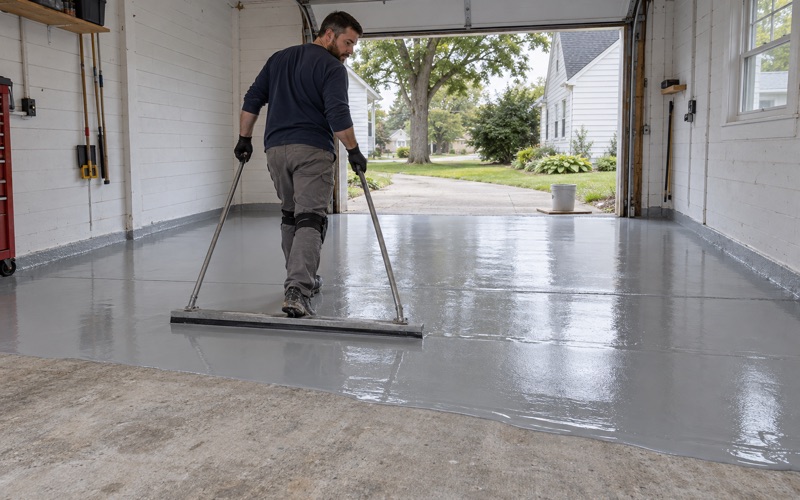
For a public room we often look at a 100% solids epoxy base with a polyaspartic or polyurea topcoat, which keeps odor and solvent low during installation. On the Iowa side, low odor is a comfort and re-entry choice, never a legal requirement. The proposal names the product line, the coat count and the finished thickness so the floor can be checked against the quote.
A slip-resistant texture for a public room
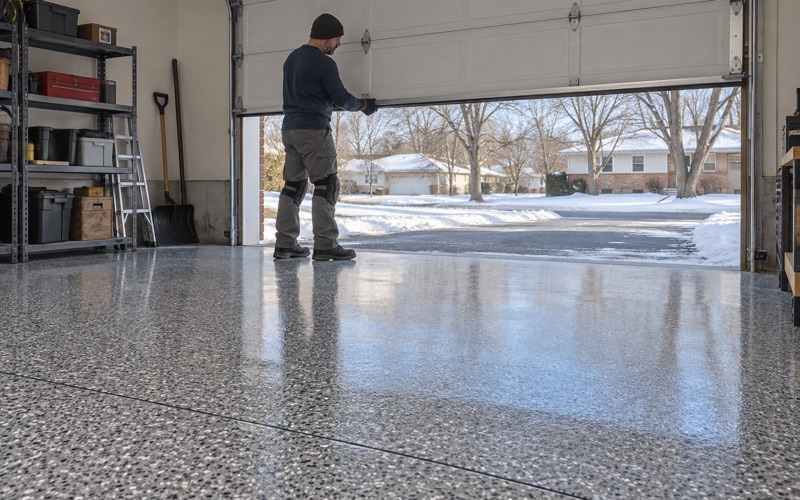
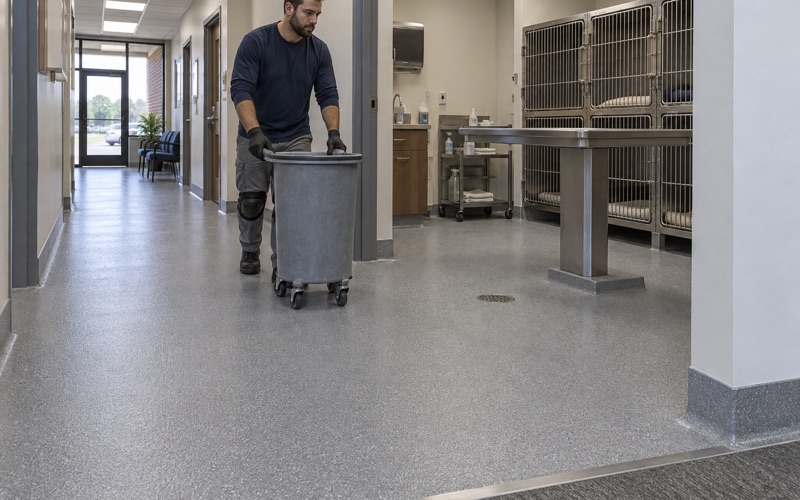
A smooth gloss coat is easy to clean but can be slick where wet shoes come in from outside. We set traction by the broadcast and topcoat chosen, often a fine quartz aggregate broadcast locked under the clear coat, and we write it into the scope instead of promising it as a slogan. The texture has to balance grip against how easily the floor scrubs.
In a room used for reading programs or meetings, a vinyl flake broadcast also hides scuffs and dust between cleanings. We help pick the broadcast density to suit how the room will be mopped, since a heavy texture holds dirt that a lighter one releases. Either way, the finish stays a hard surface that dries quickly.
What a resin floor will not do
A coating is not waterproofing, and it is not mold cleanup or flood protection. It does not stop water entering through foundation walls or through the slab, and we put that in writing on every proposal. If water is reaching a basement, the fix belongs at the source first.
Our warranty conversations start from the same point. Moisture is the first exclusion we name, and we explain the rest before a job is sold so nobody learns about it after a failure. Older basement floors also get read for signs of past water, with the floor drain and any sump pit checked, because a coating does not stop seepage.
Testing the Slab Before a Below-Grade Room Reopens
Starting with a quick screen
An ASTM D4263 plastic sheet test is a simple first look: tape down a sheet, wait, and check for darkening or droplets underneath. It flags obvious trouble but does not give a number we can design to. We treat it as a screen, not a verdict.
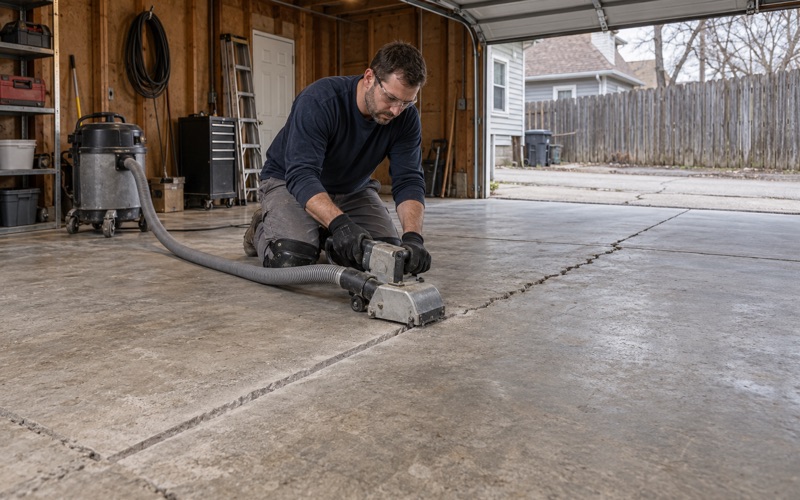
Alongside it, we map cracks, spalls and any old coating on the slab. A basement that has been closed may carry patches, adhesive from an earlier floor or worn paint, and each one changes the plan. When the slab needs repair or replacement before it should be coated, we tell the owner directly.
Measured tests that decide whether a coating can bond
For numbers, we use ASTM F1869 calcium chloride testing for moisture vapor emission and ASTM F2170 in-situ relative humidity probes set into the slab. Results are read against the coating maker’s limits and ASTM F710 thresholds. Moisture testing decides whether a coating can bond at all, so it sits in the written scope before the price is final.
If the readings come back high, the honest answer may be to wait while the humidity plan does its work and then retest. Coating a slab that is still giving off moisture invites blistering and lost bond, which could leave a public room closed a second time. We would rather report a slow slab than install a fast failure.
Profiling, dust and timing the work
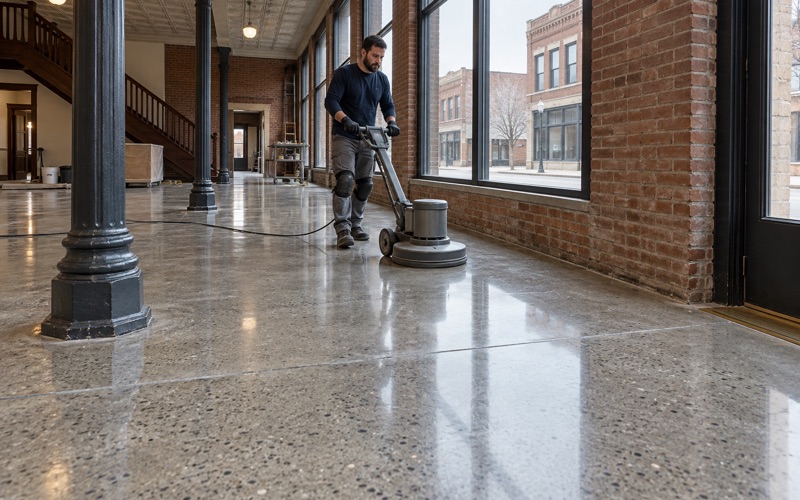
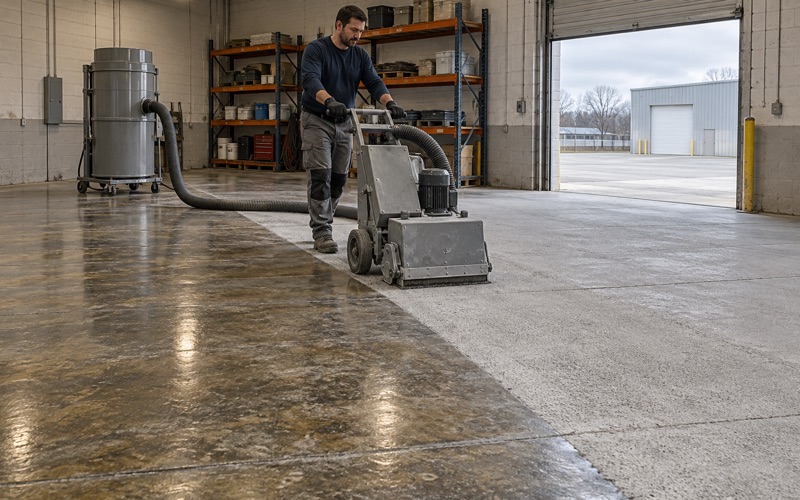
Once a slab tests acceptable, we open it with a diamond grinder or a shot blaster to a profile on the ICRI CSP scale, never with an acid etch. Acid adds water and residue to the very slab we just tested. Grinding gives the primer a real texture to grip.
Dust is captured at the machine with a vacuum rather than washed toward a floor drain, which matters in a basement where the drain is part of the moisture picture. A public building can be phased around its hours so a room stays closed no longer than the work needs. Then the floor goes back into service as a hard surface that can be scrubbed and dried.
- 20+ Years on Concrete Floors
- Moisture Tested Before Pricing
- Diamond Ground, Never Acid Etched