Moline Epoxy Flooring brings more than 20 years of epoxy flooring work to Campbell’s Island, and on this island the job often starts one step before the grinder. Many of the floors we are asked to coat are not bare concrete. They carry old vinyl or asphalt tile, or the black adhesive left behind when somebody pulled that tile up decades ago, and that layer decides how everything after it proceeds.
Our coating systems need an open, profiled slab, which means diamond grinding or shot blasting rather than an acid etch. That is exactly the kind of work a federal rule restricts on resilient flooring installed no later than 1980, until someone qualified determines what the material is. So we plan an older floor in two parts: first settle what the old covering is, then prepare and coat the concrete underneath it.
This page walks through how that plays out in a house here. It covers what usually sits on these floors, what OSHA’s construction standard requires of whoever removes it, why testing comes before any grinding, and which office handles permits for an island that is not part of the city across the bridge.
From Resort Cottages to a Ring Road of Older Houses
What the housing record shows
Campbell’s Island is an island and unincorporated community in the Mississippi River, in Hampton Township, joined to East Moline by a bridge. Census estimates for 2020-2024 count 177 housing units there, and 171 of them are detached houses. The same estimates put 171 of the 177 before 1980, with 90 built in the 1950s.
Before that building wave, the island was a resort of rental cottages and summer cabins through the early and middle 20th century. The houses along the ring road today grew out of that history, and many have been remodeled more than once since. That matters to us because each round of remodeling tends to leave another layer on the floor.
Why the decade is only half the story
A build year does not tell us what is on a floor. A 1950s house might have had its tile replaced in the 1990s, and a later addition might sit beside an original room with its first flooring still down. What changes the job is a rule about flooring installed by a certain date, and that rule follows the material rather than the age of the house.
We still ask owners what they know about the floor, because it helps. If someone knows a floor went down after 1980, or has paperwork showing it was tested, the plan changes. If nobody knows, the rule tells everyone what to assume.
Garages, basements and back rooms
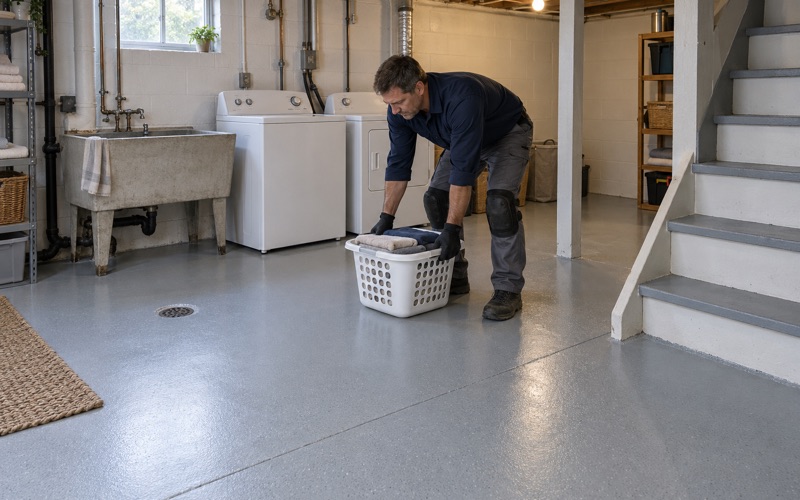
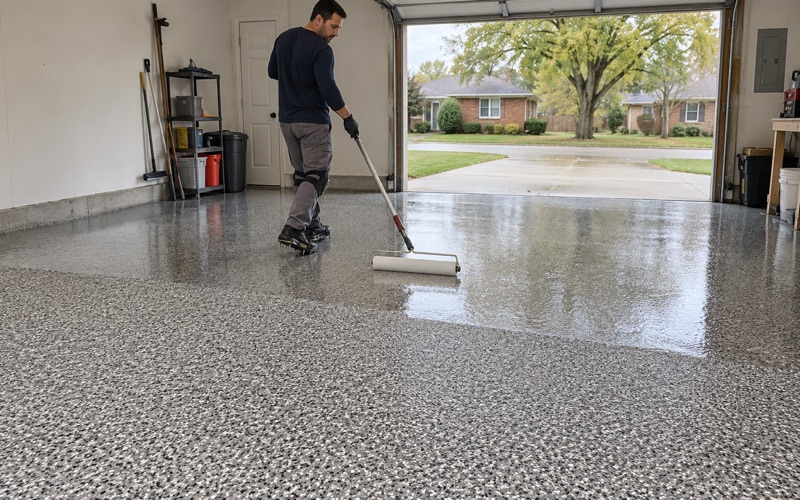
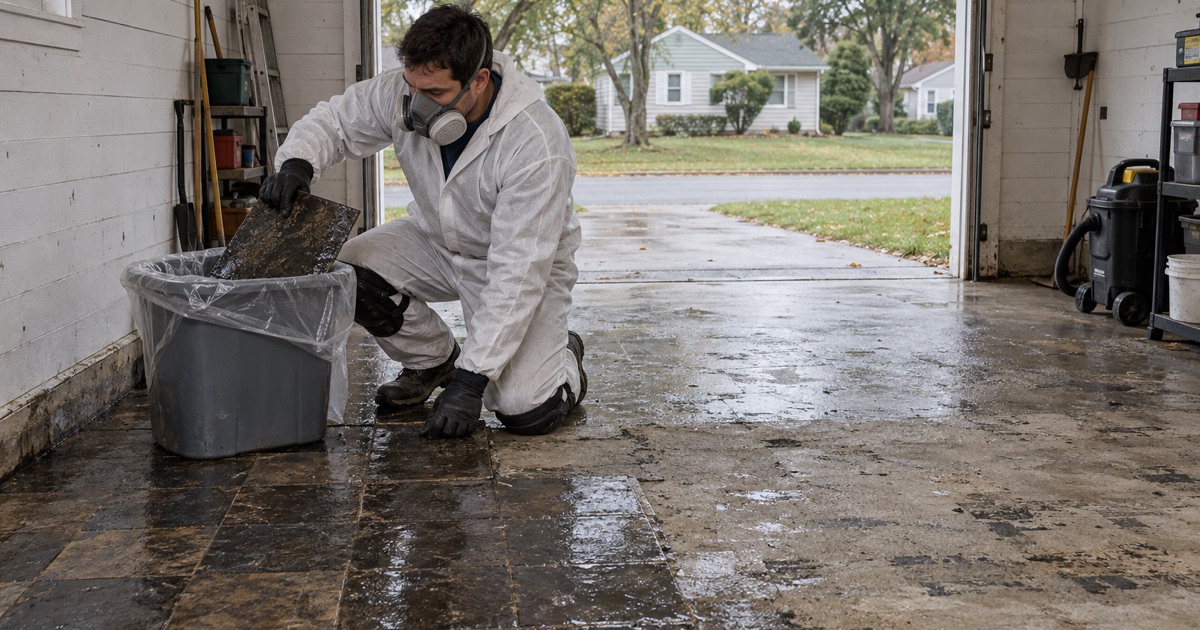
Garage slabs here are often bare concrete, and those go straight to our usual moisture testing and surface preparation. Basements, enclosed porches and utility rooms are where we most often find old tile, sheet flooring, or a black mastic outline where tile once sat. Some island homes are raised to limit flood damage, which can put the slab we coat at ground level rather than below grade.
Whatever the room, we map cracks, spalls and old coatings before pricing, and we say so when a slab needs repair before it is worth coating. On an older floor, that map also marks every patch of resilient flooring and adhesive we can see, so the owner knows from the first visit which areas carry an open question.
Looking for epoxy-flooring closer to Bettendorf? See Epoxy-Flooring Services in Bettendorf.
Old Tile, Black Mastic and OSHA’s Flooring Rule
What 1926.1101 says about older resilient flooring
OSHA’s construction asbestos standard, 29 CFR 1926.1101, covers construction, alteration, repair, maintenance and renovation of structures. Under paragraph (k)(1)(i), asphalt and vinyl flooring material installed no later than 1980 must be considered asbestos-containing unless it is determined otherwise. Paragraph (g)(8)(i)(I) adds that resilient flooring, including associated mastic and backing, is assumed asbestos-containing unless an industrial hygienist determines it is asbestos-free using recognized analytical techniques.
That is a presumption, not a finding. We have no information that any particular house on the island contains asbestos, and the rule does not say one does. It says what a contractor must assume about a floor that nobody has tested.
Why it reaches a single-family house
Some homeowners have heard that federal asbestos rules stop at the front door of a house. One EPA rule does leave out small residential buildings, but OSHA’s construction standard governs the employer doing the work, and that includes work inside a single-family home. When a crew is paid to work on a floor here, the flooring rules travel with the crew.
For us, that settles the question before it comes up. If there is old tile or adhesive on a floor we have been hired to coat, the rule shapes the plan, whether the house began as a cottage or was rebuilt later.
Work practices that run opposite to coating prep
The rule’s work practices read like a list of everything a coating prep normally does. Flooring or its backing shall not be sanded, and scraping of residual adhesive must be done with wet methods. Dry sweeping is prohibited, mechanical chipping is prohibited unless it happens inside a negative pressure enclosure, and tiles are to be removed intact where that is possible.
A standard epoxy prep, by contrast, grinds the surface to an ICRI concrete surface profile and vacuums up the dust. Run a grinder across an untested mastic layer and the job has done what the rule forbids. That is why old tile and black adhesive are a testing question for us, never a grinding question.
Test First, Then Grind and Coat
Who determines what the old floor is
We do not test flooring for asbestos, we hold no abatement license, and we do not decide whether a floor is asbestos-free. Under the rule, that determination belongs to an industrial hygienist using recognized analytical techniques. When we find old tile or mastic, we tell the owner plainly and pause the coating plan until that question is answered.
If an industrial hygienist finds the material asbestos-free, it falls outside the presumption, and ordinary removal and preparation can go ahead. If not, the removal is work for someone qualified to do it under the standard. Our part starts once the bare slab is ready.
What happens once the slab is bare
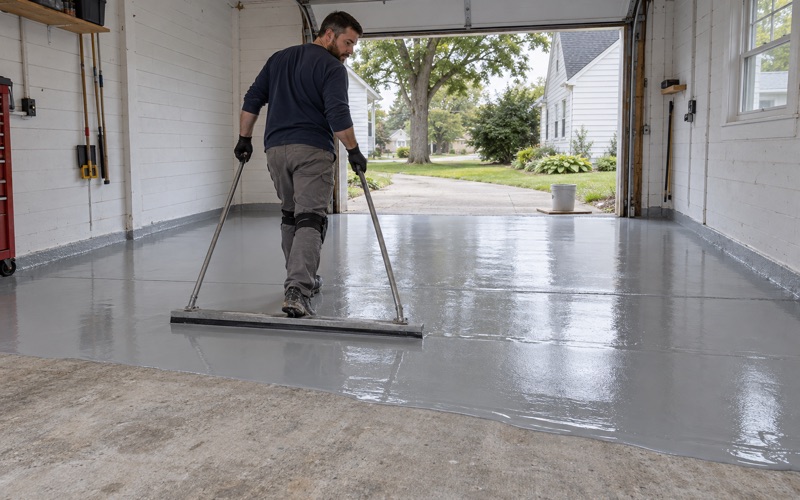
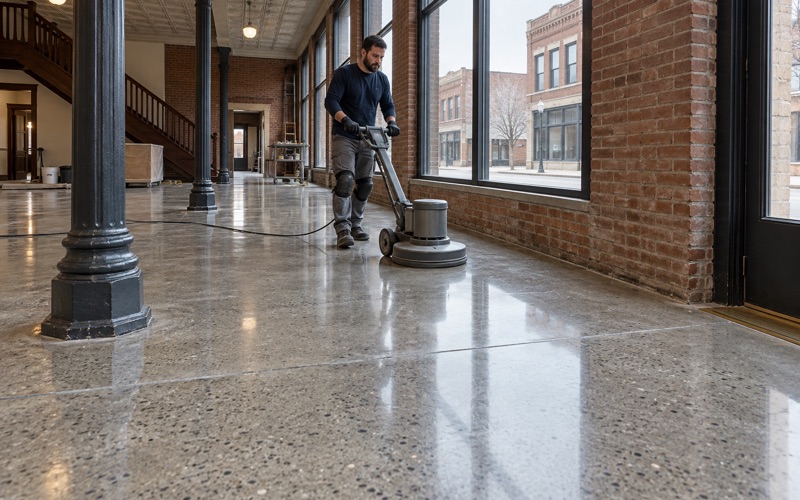
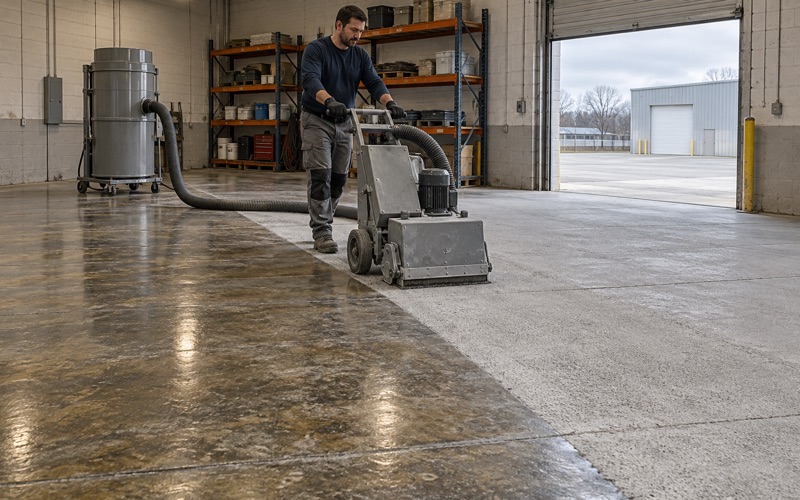
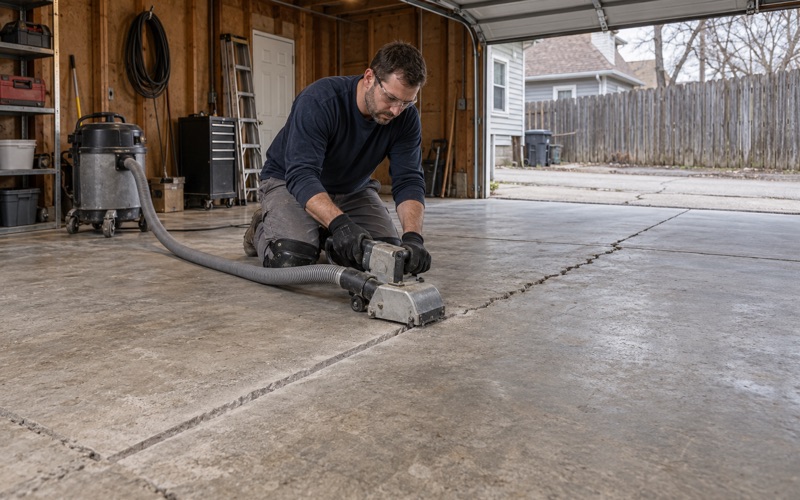
With the old covering resolved, a floor here gets the same scope we write anywhere. Every slab is opened with a diamond grinder or shot blaster, never acid etched, so the coating has a real profile to grip. Grinding dust is captured at the machine by a vacuum rather than rinsed toward a floor drain.
Moisture testing goes into the written scope before the price is final, in a basement or a garage alike. Depending on the slab, that may be an ASTM F1869 calcium chloride test, ASTM F2170 relative humidity probes, or an ASTM D4263 plastic sheet check as a first read. High readings can call for a moisture-mitigation primer under the main coat.
Choosing a system for an island garage
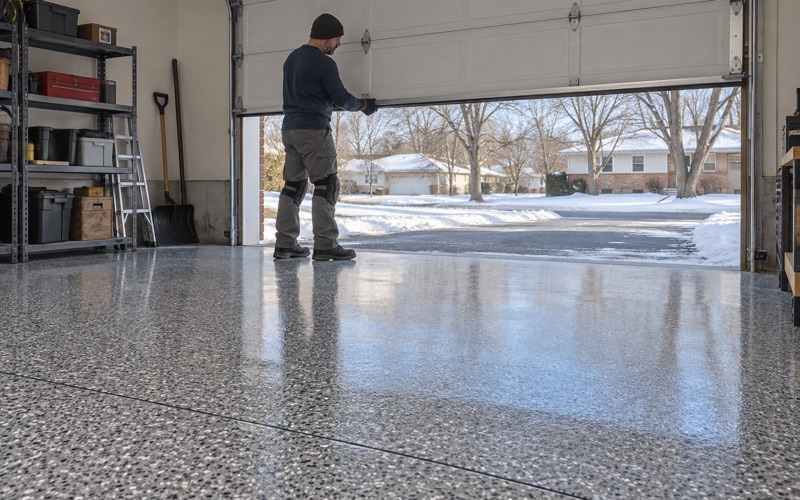
Garage systems are picked to stand up to the brine and rock salt that ride in on tires all winter, often 100% solids epoxy with a vinyl flake broadcast and a polyaspartic topcoat. Any slip-resistant texture is specified by the broadcast and topcoat we use, not promised as a slogan. The proposal names the product line, the number of coats and the finished thickness, so the floor can be checked against the quote.
Cure timing follows slab temperature and the dew point spread at the surface, not the calendar, and an unheated garage in a Quad Cities winter is told to wait. In Illinois, we use floor coatings that meet the VOC limits in 35 Ill. Adm. Code Part 223 for the person applying them.
Permits and Paperwork Go Through Rock Island County
An East Moline address, a county jurisdiction
Island mailing addresses read East Moline, but Campbell’s Island is unincorporated, and the Census geocoder places island addresses in the Campbell’s Island census place rather than the city. Building matters for unincorporated areas go through the Rock Island County Office of Zoning and Building Safety, at 1504 3rd Avenue in Rock Island, not through East Moline’s city hall.
The county asks contractors working in unincorporated areas to register each year, with a $50 registration running March 1 through February 28, a continuous $10,000 compliance bond and a certificate of insurance on file. Permits are to be pulled before work starts and posted on site, and work started without one is charged a double fee.
Which codes the county applies
The county’s contractor letter for the 2025-2026 registration year says it uses the 2012 International Codes, including the Building, Residential and Existing codes, along with the 2011 NEC and the 2021 Illinois Energy Code. The same letter says the county may move to the 2021 ICC cycle, with no date set.
Whether a given job needs a permit depends on its scope. A slab replacement or a garage rebuild is a different matter from a coating over sound concrete, so we confirm with the county office what applies before the schedule is set, rather than borrowing the answer from across the bridge.
Wells, water and what we put in writing
WVIK reported in 2019 that a majority of homes on Campbell’s Island get their water from wells. Capturing grinding dust at the machine keeps slurry and fine dust out of floor drains in the first place, and that is how we work in every house.
A floor coating does not stop seepage, and we state in writing that it is never waterproofing, flood protection or radon work. In an older basement we look for past water first, checking the floor drain and any sump pit, and efflorescence on the slab tells us water has moved through it before. Moisture vapor transmission and hydrostatic pressure are the first warranty exclusions we name, before the job is sold rather than after a problem appears.
- 20+ Years on Concrete Floors
- Moisture Tested Before Pricing
- Diamond Ground, Never Acid Etched