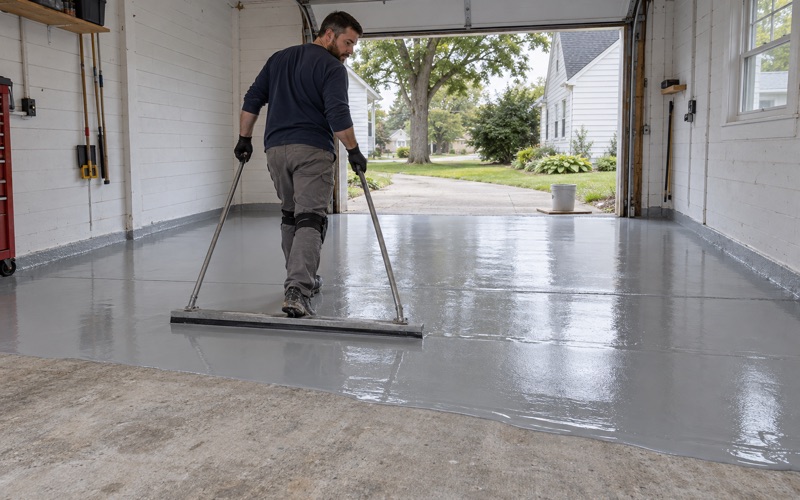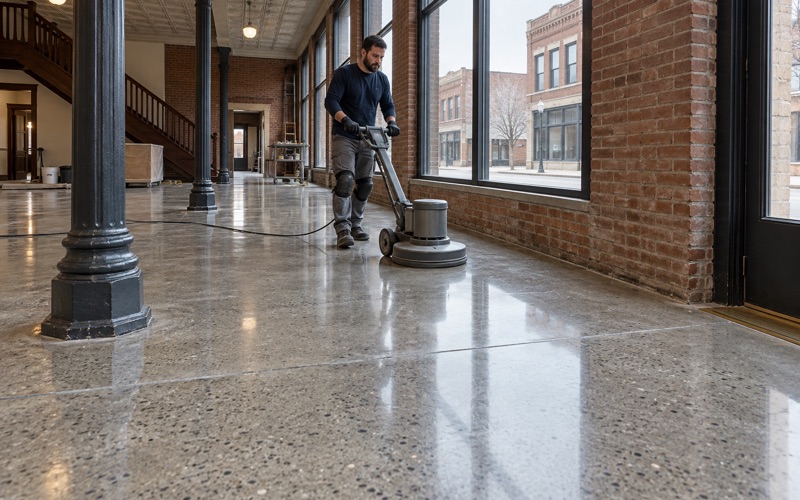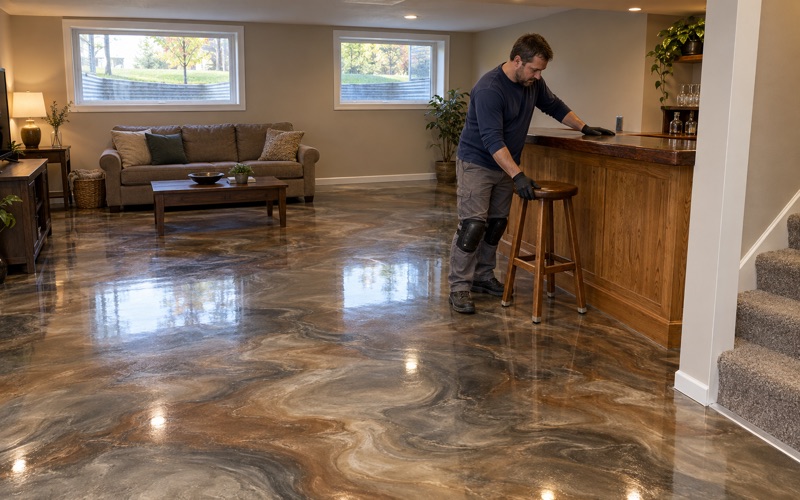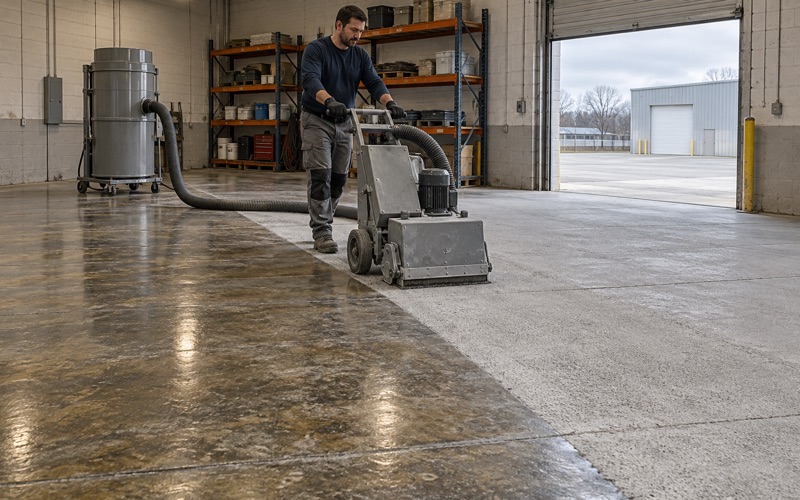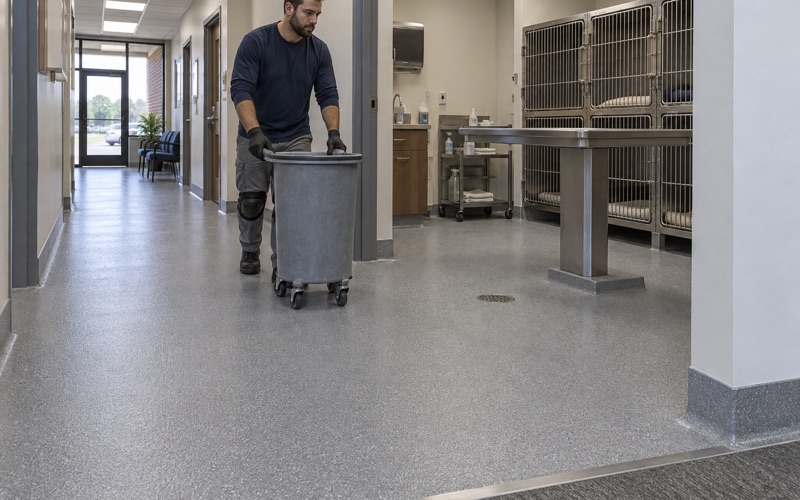
Moline Epoxy Flooring brings epoxy flooring in Clinton, Iowa to process plants, shops and homes, backed by more than 20 years of slab work. On a production floor we start by asking what reaches the concrete, how hot it is when it lands, and how long it sits before someone cleans it up. Those three answers shape the system far more than any label on a pail does.
Concrete is strong, but it is not inert. Some of the liquids that move through food and beverage processing can react with an unprotected slab, and the sensible response is a protective treatment matched to the exposure. Our proposal names the product line, the number of coats and the finished thickness, so an owner can hold the installed floor up against the quote.
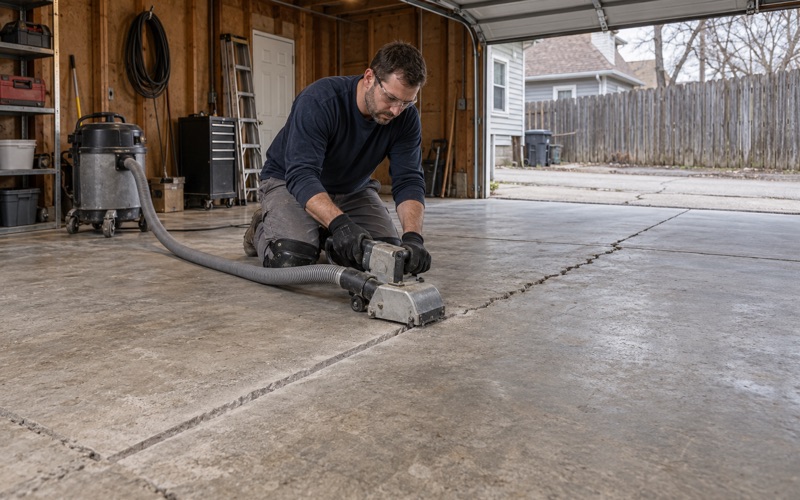
Homeowners on the Iowa side get the same diligence on a garage or basement. A moisture test is written into the scope before the price is final, cracks and old coatings are mapped first, and we say plainly when a slab needs repair before it should be coated. Low-odor products are a comfort and re-entry choice here, never a legal requirement.
Clinton’s Corn Wet Mill and the Floors Around It
A Century-Old Mill on the Riverfront
Clinton is the county seat of Clinton County and sits on the Mississippi River. Clinton and Lyons were major lumber centers from the 1850s to 1900, the era that earned the nickname Lumber Capital of the World. Today one of the city’s anchors is ADM, which took over the Bioprocessing Facility in 1982 and has since invested in rebuilding what was described as the 100-year-old Clinton wet mill.
Local reporting in 2022 said the plant processes over 350,000 bushels of corn per day, and a May 2026 report said ADM employs over 750 people in the area. Those figures describe the scale of the operation and nothing about its floors. We make no claim about the condition of any ADM slab, and we have never presented ourselves as a contractor to that plant.
What a Corn Wet Mill Produces
A corn wet mill breaks corn into its main components, starch, oil, protein and fiber, and turns them into finished products. The 2026 report lists sweeteners, starches, ethanol and beverage alcohol at the Clinton site. An earlier description of the plant adds corn oil, enzymes, animal feed and other food ingredients.
For anyone specifying a floor, that list matters because each product is a different substance arriving at a different temperature. Sweeteners and starches, alcohols and wash-down water do not behave alike on concrete. A floor beside a syrup line is a different specification problem from one at a truck door, even inside the same building.
The Rest of Clinton’s Industrial Floors
ADM is not the only manufacturer in town. Named employers include Nestle Purina, LyondellBasell, Timken, Atlas Roofing, Big River Packaging and Custom-Pak, and the LyondellBasell Clinton Complex on Anamosa Road produces ethylene, propylene and polyethylene resins. Each of those floors carries its own exposure, and each starts with the same question about what actually lands on the concrete.
Shop, plant and warehouse floors are phased around shifts, with overnight and weekend windows when a line cannot stop. We sequence grinding, coating and cure so one area returns to service before the next one closes. That keeps a coating project from becoming a production problem.
Looking for epoxy-flooring closer to Silvis? See Epoxy-Flooring in Silvis.
What ACI 515.2R Says About Chemical Attack
A Consensus Guide, Not a Product Chart
The industry reference for this question is ACI 515.2R, the Guide to Selecting Protective Treatments for Concrete from ACI Committee 515. It was adopted in July 2013 and reprinted as ACI PRC-515.2-13(23) in November 2023. Its abstract says concrete can be subjected to physical or chemical attacks by water, acids, alkalis, salt solutions and organic chemicals.
The guide states that it addresses the effects of various substances on untreated concrete and recommends protective treatments. It is a committee document rather than a sales sheet. That is why we use it to frame the conversation with a plant owner before any product is named.
Sugars and Alcohols Are on the List
The guide’s introduction cites a 1966 study by Kuenning that exposed mortars to substances including alcohols and sugars. In a city whose largest plant makes sweeteners and beverage alcohol, that places everyday products inside the scope of what concrete engineers study for chemical attack.
We have not read the guide’s detailed tables, and we do not quote a rating for any sugar, syrup or concentration. What we can say is that these substances belong in the conversation. The specific answer for a given spill comes from the coating producer’s data for that exposure.
Heat Raises the Stakes
The same introduction says high temperatures usually accelerate chemical attack compared with normal temperatures, so better protection is required as temperature rises. A spill at room temperature and a hot process stream are two different exposures, even when the substance is the same.
That is why our walk-through asks where heat reaches a floor, from cookers, wash-down or product lines, and how long a spill sits before cleanup. Those answers decide whether a thin coating, a heavier system or a different material belongs in that zone. One building can need all three.
Isolating the Slab With a Coating, Overlay or Lining
Three Defenses, and Where a Coating Fits
ACI’s guide names three mitigation methods. The second is isolating the concrete from the agents causing chemical attack with a suitable coating, overlay, lining or barrier. That is the territory a resinous floor occupies, and it only works while the barrier stays bonded and intact.
Choosing among those options depends on exposure. A 100% solids epoxy, a urethane cement overlay and a heavier broadcast system each suit different conditions. We match a system to each zone rather than coating a whole plant one way because it is simpler to bid.
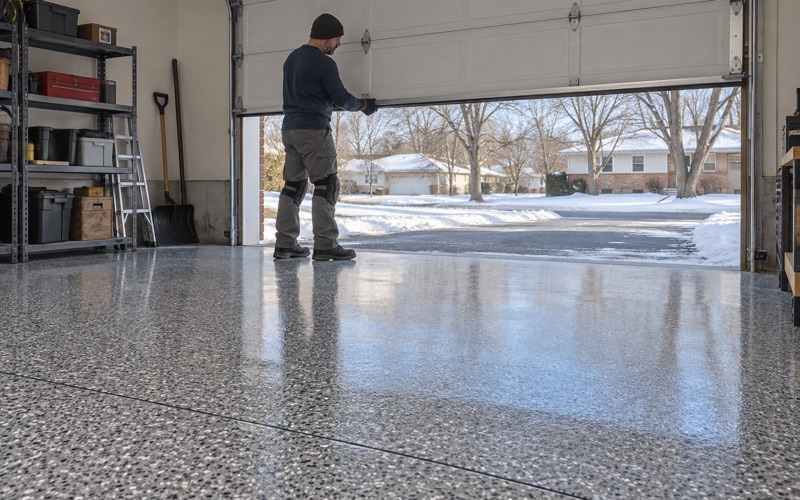
The same exposure-first reasoning carries down to a home garage. Clinton counts 6,937 owner-occupied detached houses, and on a garage slab the exposure that matters is the brine and rock salt that ride in on tires all winter. We choose garage systems to hold up to that, not to a showroom photo.
Bond Strength Comes First
The guide also says that when a protective material is bonded to concrete, bond strength should be evaluated. A barrier that lets go at its edges allows a spill to reach the slab underneath, where nobody can see the damage developing.
Bond starts with preparation. We open every slab with a diamond grinder or a shot blaster to the ICRI concrete surface profile the product calls for, never an acid etch. Grinding dust is captured at the machine with a vacuum rather than washed toward a floor drain or a storm inlet.
Bond is also a matter of timing. Cure schedules follow slab temperature and the dew point spread at the slab surface rather than the calendar, and a cold building in a Clinton winter is told to wait. A coating laid down too close to the dew point can show amine blush or lose adhesion before it ever sees a spill.
Moisture, Patches and Old Coatings
A process floor that has been in service for decades often carries old coatings, patches and spalls. We map those before quoting and name the areas that need repair or replacement before a new system goes down. Coating over a failing patch only hides the failure for a while.
Moisture is tested in writing as part of the scope, with methods such as ASTM F2170 in-situ relative humidity probes or ASTM F1869 calcium chloride testing. Moisture is also the first exclusion we name when we explain what a coating warranty leaves out, before the job is sold rather than after.
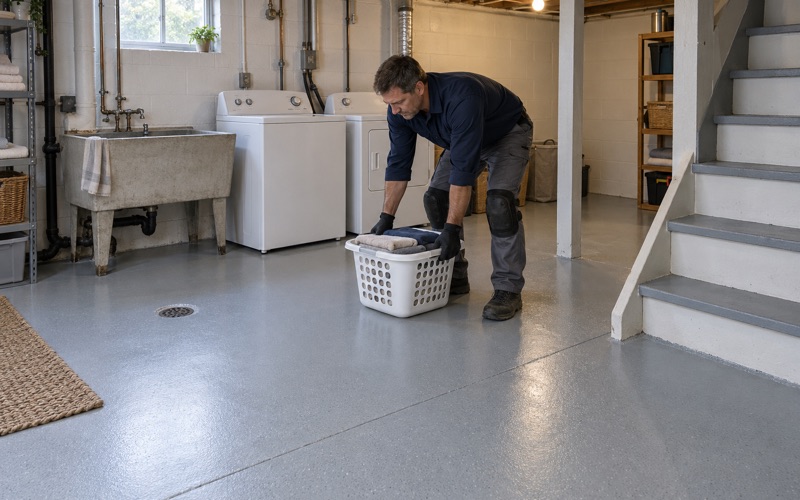
The same reading applies to Clinton homes, where census figures show 40.9 percent of the housing was built in 1939 or earlier. An older basement floor is read for past water first, with the floor drain and any sump pit checked. A coating does not stop seepage, and we will not sell one as if it did.
Producer Data and the FDA Question
The Producer’s Recommendation Governs
ACI’s guide is explicit that specific recommendations from material producers should be followed instead of its general guidance. On a process floor, our specification starts from the coating maker’s own data for the substance, concentration and temperature in question.
No coating stands up to everything a plant can spill. Our proposals say which exposures a system was chosen for and which it was not, so the owner knows where the limits sit. That honesty matters more on a floor near a hot sweetener line than anywhere else in the building.
Coatings Near Food Ingredients
A note in the guide flags substances used in food processing or as food or beverage ingredients. It advises asking the Food and Drug Administration for an advisory opinion on coatings used with food ingredients. We pass that point along to plant owners plainly rather than describing any product as cleared for food contact.
Where a floor sits near food ingredients, the owner’s food safety team and the coating producer belong in the selection. We install the product they settle on, with a slip-resistant texture specified by the broadcast and topcoat rather than promised as a slogan.
Who Inspects and Who Permits in Clinton
Restaurant and retail kitchens in Clinton County fall directly under the Iowa DIAL Food Safety Bureau, which inspects to the 2017 Food Code with Supplement under 481 IAC 31.1. We plan those kitchen floors with coved bases and a texture chosen for wet areas, around the plan review of the authority that inspects them.
Building questions go to the City of Clinton. Every quote we write names Moline, Illinois as our base and Clinton, Iowa as the job site, because the rules change at the river. A floor coating is never sold as waterproofing or flood protection, and we put that in writing.
- 20+ Years on Concrete Floors
- Moisture Tested Before Pricing
- Diamond Ground, Never Acid Etched