
Moline Epoxy Flooring handles concrete floor repair in Moline, IL, serving surrounding cities including Silvis, Milan, Rock Island, Campbell’s Island and Bettendorf. In more than 20 years of coating and polishing floors, we have learned that a new finish is only as good as the slab it sits on, so the repairs come before the color.
We repair cracks, spalls, pitting, salt scaling, damaged joints and old patches, usually as part of preparing a floor for a coating or a polish. Every crack and damaged area is mapped before we price the job.
Sometimes the honest answer is that a slab should be replaced, not repaired. When the damage is too widespread or the concrete is moving, we tell you before any money is spent on a coating that would only cover the problem for a while.
Cracks and Joints
Hairline and Shrinkage Cracks
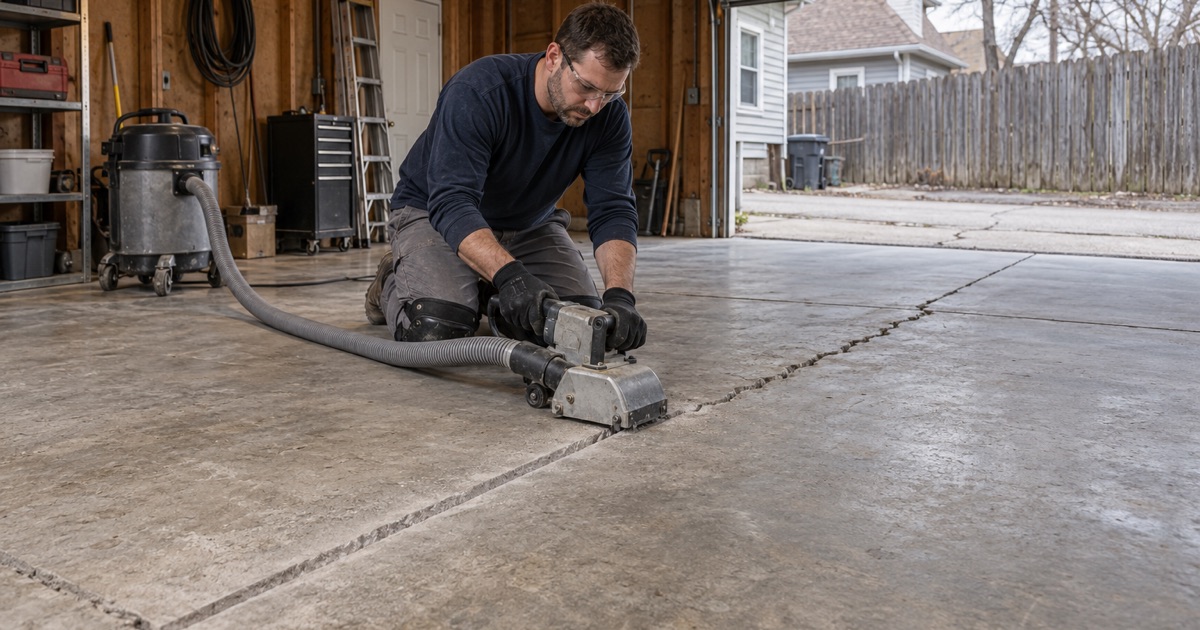
Most slabs develop fine shrinkage cracks as they cure and age. These are usually stable and can be opened slightly with a grinder, cleaned and filled with an epoxy or polyurea crack filler, then ground flush so they do not show through the finish. We still map them, because a pattern of cracks can tell us about movement or moisture that matters for the coating choice.
Structural and Moving Cracks
Wider cracks, cracks with one side higher than the other and cracks that keep growing point to settlement or movement in the slab. Filling them rigidly can make the coating crack along the same line later.
We identify which cracks are moving before choosing a repair, and in some cases recommend leaving a joint in the coating rather than pretending the slab is one solid piece.
Control Joints
Saw-cut control joints are meant to let the slab crack in a straight line. In homes, they can often be filled and coated over. In warehouses and plants, joint edges chipped by forklift wheels are rebuilt and filled with a semi-rigid filler that supports the wheels while allowing small movement.
Spalls, Pitting and Salt Damage
Spalled Concrete
A spall is a section of concrete that has broken away from the surface, often near joints, edges or where something heavy was dropped. We cut back to sound concrete, clean the area and rebuild it with a polymer-modified repair mortar or epoxy mortar. The repair is then ground flush with the surrounding floor, so the coating sits on a continuous surface.
Freeze-Thaw Scaling
Garage floors and entry slabs that see rock salt and calcium chloride brine often develop freeze-thaw scaling, where the surface flakes off in thin layers near the door and along the tire paths. Salt brine soaks in, freezes and expands, breaking the surface apart.
We grind scaled areas back to sound concrete and resurface them before coating. A coated floor then keeps salt brine on the surface where it can be cleaned away.
Pitting and Pop-Outs
Small pits and pop-outs leave a rough surface that holds dirt and shows through thin coatings. They are filled and ground smooth as part of the repair work.
On a flake floor, small filled pits disappear under the broadcast. On a solid color or metallic finish, we take more care to get every pit filled and flush, because those finishes show the surface underneath.
Old Patches, Uneven Areas and Replacement
Failed Patches
Older floors often carry old patches that have loosened, cracked around their edges or turned powdery. Those are removed and replaced, because a coating bonded to a loose patch will fail along with it.
We sound the floor by tapping and dragging a chain across it, listening for the hollow note of a patch or topping that has let go. Those areas are cut out even when they look fine on the surface.
Uneven Areas
High spots and lips at joints are ground down. Low areas are filled with patching compounds or self-leveling material where needed, especially for metallic finishes and polished floors that show every variation.
In garages, a slab that has settled toward the house instead of draining toward the door can sometimes be corrected with patching along the low edge. Major drainage problems usually call for replacement instead.
When Replacement Is the Answer
A slab that is broken into moving pieces, heaved, badly sunk or crumbling across large areas is not a coating candidate. In Moline, a detached garage slab built to the city’s code is at least 4 inches of air-entrained concrete, and if that slab has failed, we recommend replacement before any coating.
We would rather lose a coating job than coat a floor that will crack through within a year. If replacement is the answer, we explain why and what the new slab will need before it can be coated.
Repairs and the Coating System
Matching Repair Materials to the Finish
Repair materials are chosen to bond with the coating that will cover them and to handle the same traffic. A repair that is softer or harder than the slab around it can show through or crack at its edges. Forklift aisles, for example, need joint fillers and repair mortars that support hard wheels, while a home garage needs repairs that tolerate winter brine and temperature swings.
Moisture Before Repair
Moisture affects repairs as much as coatings. We test the slab before choosing repair materials, and we look for efflorescence and signs of water that could undermine both the repair and the floor system above it.
Some repair materials tolerate damp concrete better than others. Knowing the moisture level first lets us choose a material that will stay bonded instead of one that only looks right on install day.
Written Repair Scope
The proposal lists the repairs we found and what each will get, so you know what the price covers and what the floor will look like when it is done.
If grinding uncovers damage we could not see during the walk-through, such as a hollow topping under old paint, we stop and show you before adding anything to the scope.
- 20+ Years on Concrete Floors
- Moisture Tested Before Pricing
- Diamond Ground, Never Acid Etched