
Moline Epoxy Flooring provides concrete grinding in Moline, IL, serving surrounding cities including Silvis, Milan, Rock Island, Campbell’s Island and Bettendorf. After more than 20 years of preparing slabs for coatings and polishing, we see grinding as the step that decides whether a floor lasts, because no coating bonds better than the surface it is put on.
We grind slabs to remove old coatings, glue, sealers and stains, to take down high spots and joint lips, and to open the concrete to a consistent profile. Shot blasting is our other tool for large open floors. Acid etching is not part of how we work.
Grinding is also the step where problems show up. Cracks, spalls, soft spots and hidden repairs appear once the surface is opened, and we map them and tell you what they mean for the floor before going further.
Diamond Grinding and Shot Blasting
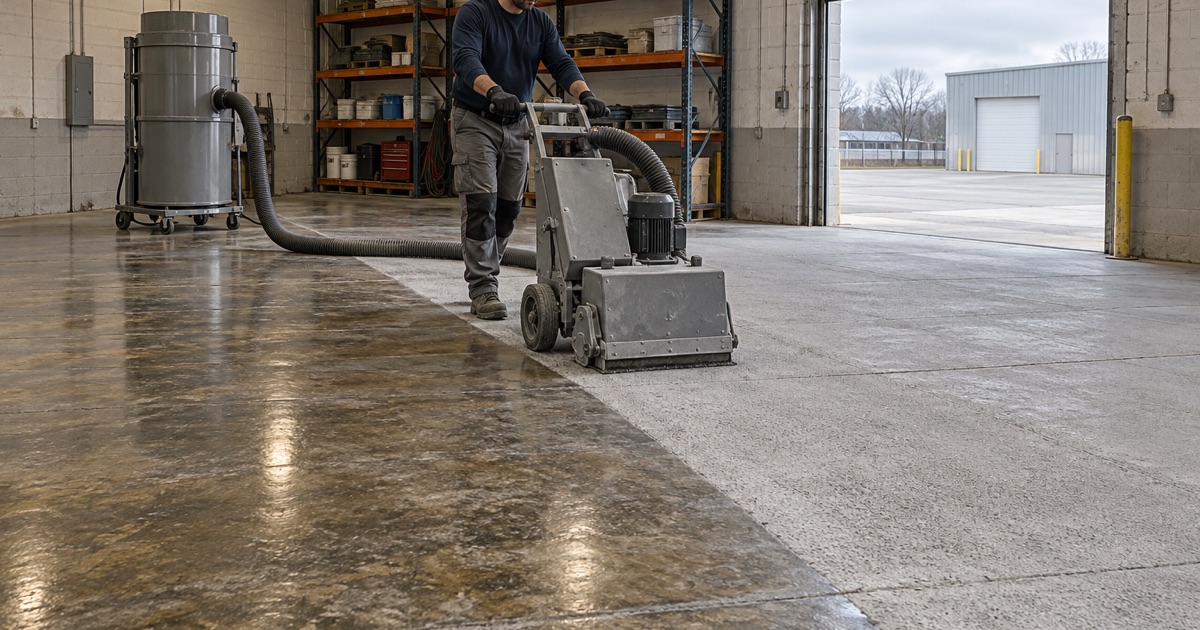
Diamond Grinding
A diamond grinder uses rotating heads fitted with diamond segments to cut the concrete surface. Coarse metal-bonded tooling removes coatings and opens the slab, while finer tooling refines the scratch pattern for thinner coatings or polishing.
Grinders reach close to walls and handle residential garages, basements and smaller commercial rooms well. Edges and corners are finished with smaller hand grinders so the profile is consistent right up to the wall.
Shot Blasting
A shot blaster throws small steel shot at the concrete, cleaning and roughening it in one pass, then recovers the shot and the debris into a collector. It is fast on large, open floors in warehouses, plants and parking areas.
Shot blasting leaves a textured profile that suits thicker coatings and urethane cement systems. It is less suited to small rooms and edges, so we often pair it with grinding along walls.
Choosing Between Them
The choice depends on the floor size, what is on the surface and the profile the next system needs. Many larger jobs use both, with the shot blaster on the open floor and grinders on edges and tight areas.
We make that call after seeing the floor, not before. A warehouse with a thin sealer may blast cleanly in one pass, while the same size floor under thick old paint may need grinding first, and the written scope says which method each area gets.
Surface Profile and Why It Matters
The ICRI CSP Scale
The International Concrete Repair Institute publishes a concrete surface profile scale from CSP 1, nearly flat, to CSP 10, very rough. Coating manufacturers specify a profile range for each product, and thin coatings need a finer profile than thick mortar systems.
We match the grinding or blasting to that range and compare the result against profile samples. A profile that is too smooth gives the coating too little to grip, and one that is too rough can show through a thin finish.
Removing the Weak Top Layer
The top of a concrete slab is often a thin, weak layer of fine particles called laitance, along with dirt, oil and old sealers. Coating over it means bonding to something that can peel away from the solid concrete underneath.
Grinding removes that layer and exposes sound concrete. It is the reason a professionally prepared floor holds where a coating over an unprepared slab fails.
Why We Never Acid Etch
Acid etching dissolves a little of the surface, but it does not remove sealers or oil, it leaves salts that have to be rinsed away and it produces an uneven profile. It also puts more water into a slab that will soon be coated.
Most store-bought coating kits rely on etching, which is one reason so many of them peel within a couple of years. A ground slab costs more to prepare, but it is the part of the job that keeps the coating on the floor.
Removing Old Coatings, Glue and Contamination
Old Paint and Epoxy
Peeling paint and failing epoxy have to come off completely before a new system goes down. We grind them away with tooling designed for coating removal, checking the bare concrete for damage as it appears.
What we find under an old coating often explains why it failed. Moisture staining, efflorescence or a slick, unprepared surface tells us what to do differently this time, and we note it in the scope.
Tile Mastic and Carpet Glue
Older floors often have black mastic from old tile or adhesive from carpet and sheet flooring. These materials gum up tooling and must be fully removed. On older buildings, we discuss testing tile and mastic for asbestos before grinding them, rather than assuming they are safe to disturb.
Oil and Grease Stains
Oil soaks into concrete in garages, shops and plant floors. Surface oil is ground out, and deeper contamination may need cleaning and additional grinding before the floor will accept a coating.
Old machine shop and equipment floors can hold decades of oil below the surface. On those slabs, we test small areas first, because oil that keeps wicking up after grinding can lift a coating from below, and some floors are better suited to a different system.
Dust Control and Cleanup
Vacuum Capture at the Machine
Our grinders and shot blasters run with dust-collecting vacuums that capture debris at the source. That keeps dust out of the air in the home or business and out of the rest of the building.
Concrete dust contains fine silica, so capture at the machine matters for the crew and for anyone else in the building. Filters are maintained so the vacuums keep pulling hard through the whole job.
Keeping Dust Out of Drains
We do not rinse grinding dust toward floor drains or storm inlets. Concrete fines are collected and bagged, and the floor is vacuumed clean before the next step. That keeps fines from settling in drain lines and traps, and it keeps them out of the storm system that carries water to the river.
Working Around Occupied Spaces
In homes, we seal doors to living areas. In businesses, we phase grinding by zone and schedule the dustiest work overnight or on weekends, so the building can stay in use.
Grinding is also the loudest part of a floor job. We give occupants the grinding days in advance so they can plan around the noise, and the quieter coating steps follow.
- 20+ Years on Concrete Floors
- Moisture Tested Before Pricing
- Diamond Ground, Never Acid Etched