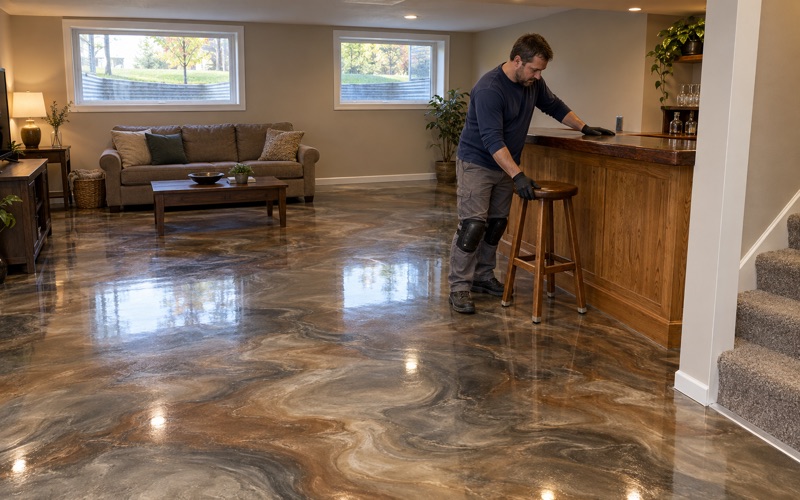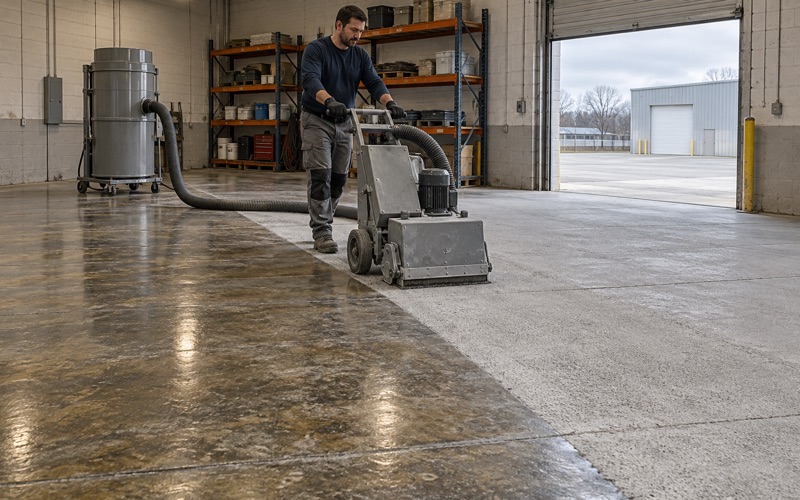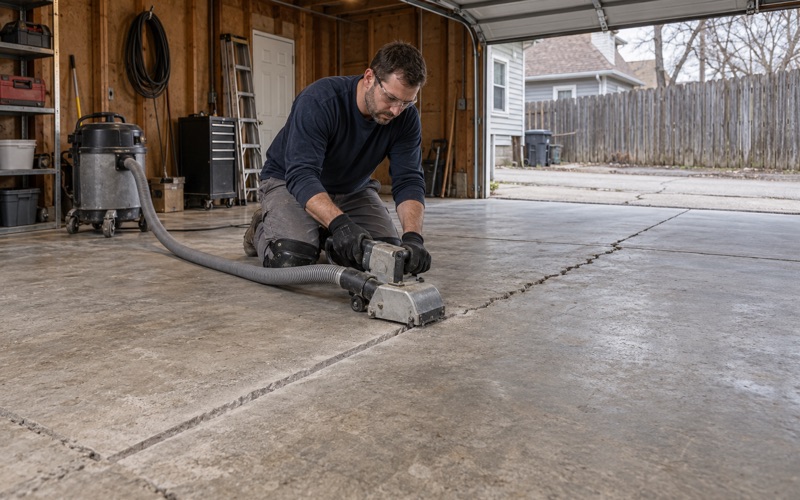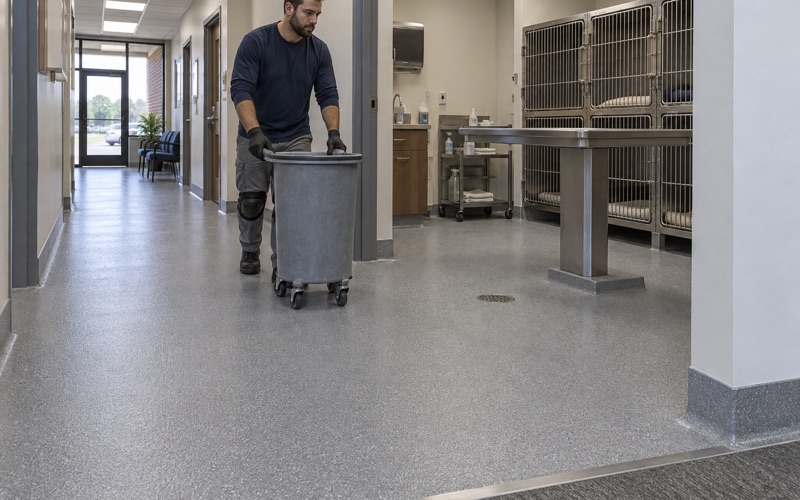
Moline Epoxy Flooring installs epoxy flooring in DeWitt for garages, basements, working shops and food-service rooms, and we bring more than 20 years of grinding and coating concrete to each one. Before we talk about color or flake, we settle what the floor has to answer to. A family garage, a plant floor and a kitchen that a state inspector walks are three separate questions, and the coating follows the answer.
Our paperwork says Moline, Illinois, at the top and names DeWitt and Clinton County where the job sits, because the rules change at the river. On this side, a low-odor system is something we choose for your comfort and a faster return to the room, never a legal requirement we sell against. Every proposal spells out the product line, the number of coats and the finished thickness, so you can hold the floor up against the quote.
This page starts with the question that sets DeWitt apart for food-service floors: when a stand operates only for one event, and when a kitchen is held to the year-round standard. After that we cover the houses and shops that make up most of our calls here, from older basement slabs to garage floors that carry rock salt in on the tires all winter.
The Clinton County Fair and the Ground It Sits On
A fair week on the town calendar
DeWitt hosts the Clinton County Fair, and the 2026 fair runs July 22-26 at the fairgrounds on East 8th Street. WQAD described it in 2013 as an 80-year-old tradition, set among historic barns. For one week the grounds fill with exhibits and visitors, and any food handed across a counter that week raises a floor question that ordinary months do not.
We want to be plain about our place in this. We have no connection to the fair, its board or any vendor on the grounds, and we have not coated anything there. We bring the fair up because it is the clearest local example of a rule that also governs church suppers, festival booths and pop-up stands across the county.
A fairground that works all year
The Clinton County Agricultural Society lists hosting the annual fair as its most significant activity, and the rest of the year its facilities serve 4-H activities and other community events. The fairgrounds auditorium at 328 E. 8th St. was posted as a polling place for the June 2026 primary. A gun show was listed there for September 4, 2026.
That range of uses is why we never assume what a building on fairgrounds is licensed as. A room that serves food for one weekend and sits empty for a month is not automatically a temporary stand, and it is not automatically a full kitchen either. We have not seen which license any food operation on those grounds holds, and we would not guess at it.
Who decides in Clinton County
On DIAL’s food inspection map, Clinton County sits under the Iowa Department of Inspections, Appeals and Licensing Food Safety Bureau directly. The inspection standard is the 2017 Food Code with Supplement, adopted in 481 IAC 31.1, and the same chapter carries a separate rule on temporary food establishments.
That bureau, not a coating, decides whether a floor meets the code. No epoxy, urethane cement or polyaspartic system carries a DIAL approval, and we never tell an owner that a product will pass inspection. What we can do is build the floor to the plain language of the code and leave the call to the inspector.
Looking for epoxy-flooring closer to Camanche? See Camanche Epoxy-Flooring.
Fourteen Days and a Single Event: Iowa’s Temporary Line
How Iowa defines a temporary stand
Iowa Code 137F.1(16) defines a temporary food establishment as one that operates for no more than fourteen consecutive days in conjunction with a single event. The same section defines an event as a significant occurrence sponsored by a civic, business, governmental, community or veterans organization, and it may include an athletic contest.
Two details in those definitions matter for a floor. The count is consecutive days tied to one event, so a stand that keeps reopening for unrelated weekends is a different conversation. And the statute counts a beverage as food, which means a lemonade or coffee booth falls under the same line as a grill.
Graded to drain: what the code allows under a stand
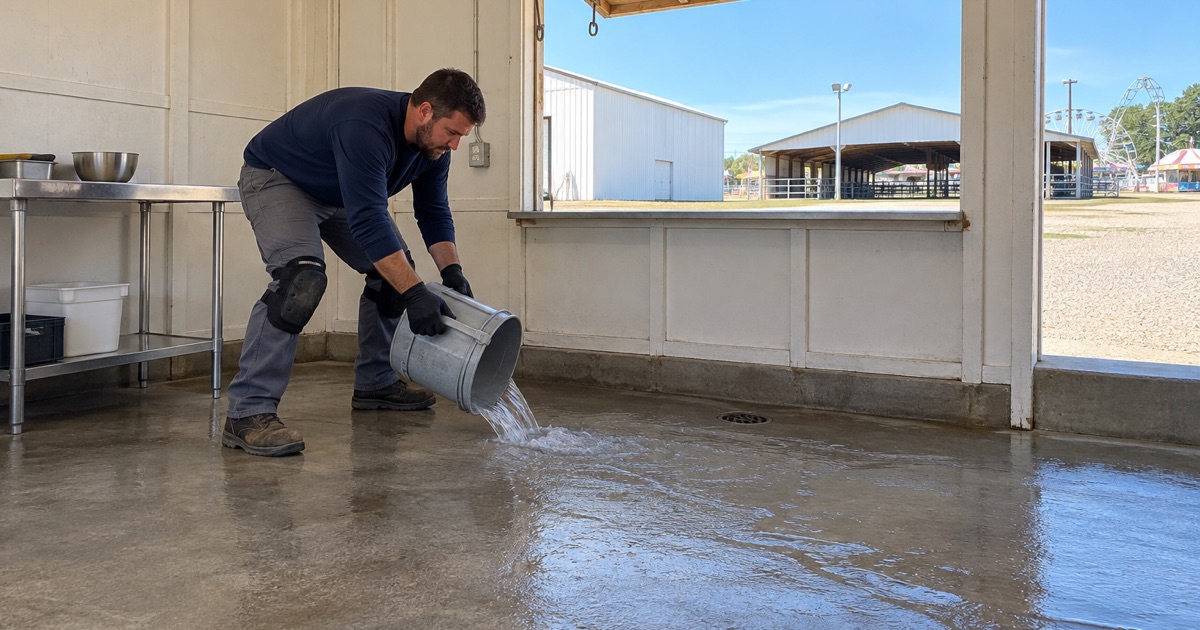
Food Code 6-101.11(B)(1) gives a temporary food establishment a looser floor rule. If graded to drain, the floor may be concrete or machine-laid asphalt. Dirt or gravel also qualifies if it is covered with mats, removable platforms, duckboards or other approved materials treated to control dust and mud.
The companion paragraph lets walls and ceilings be any material that keeps out weather and windblown dust. Put together, the code accepts a working surface under a short event that it would never accept under a restaurant. Drainage is the condition that carries the allowance, so a slab that ponds water at its low corner is the first thing we would point out.
Where a coating fits under a short-run stand
So bare concrete under a single-event stand can be lawful. When an owner asks us to coat one anyway, we treat it as a cleanability and durability choice: a sealed slab sheds spilled syrup and grease faster, and it holds up better to carts and coolers dragged across it.
We price that work honestly as an upgrade rather than a compliance step. If the plan is to run the same stand past a single event, the answer changes, and the floor beneath it moves into the year-round standard described below.
Smooth, Durable, Easily Cleanable: The Year-Round Standard
What 6-101.11(A) asks of a kitchen floor
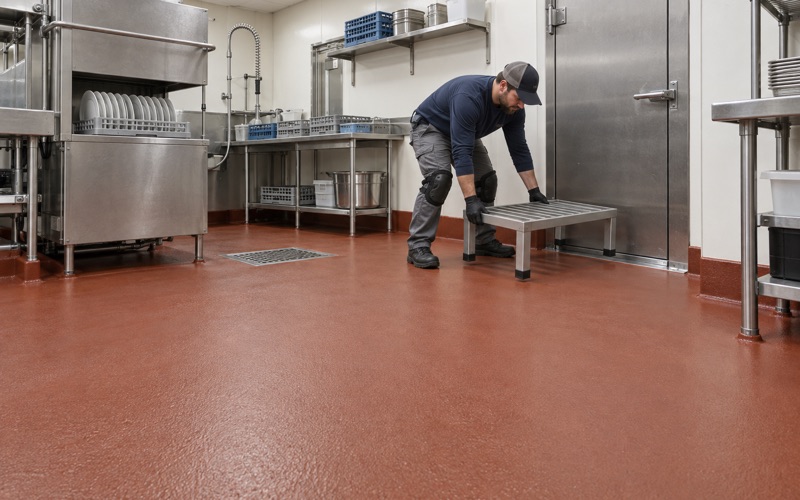
Every food establishment that is not temporary falls under 6-101.11(A). Indoor floors where food operations happen must be smooth, durable and easily cleanable. In areas subject to moisture, such as food preparation, walk-in refrigerators, warewashing and toilet rooms, they must also be nonabsorbent.
That is the language we build to in a DeWitt kitchen, bar back or prep room. Bare concrete is porous and wears into a rough surface under daily mopping, which is why owners in this category usually come to us. A coated floor gives the inspector a surface that reads as sealed and cleanable, though the inspector still makes the call.
Texture, coved bases and the antislip note
Food Code 6-201.11 repeats the smooth and easily cleanable rule and carves out antislip floor coverings or applications used for safety reasons. We treat that as room to specify texture, not as license to make a floor rough. Slip resistance comes from a named quartz aggregate broadcast and a stated topcoat, written into the scope.
Around wet stations we run a coved base up the wall so the floor-to-wall joint can be mopped clean. Urethane cement is often our pick where hot water, steam cleaning and grease meet the slab, and the proposal says which system goes where.
Preparing a slab that has to hold up
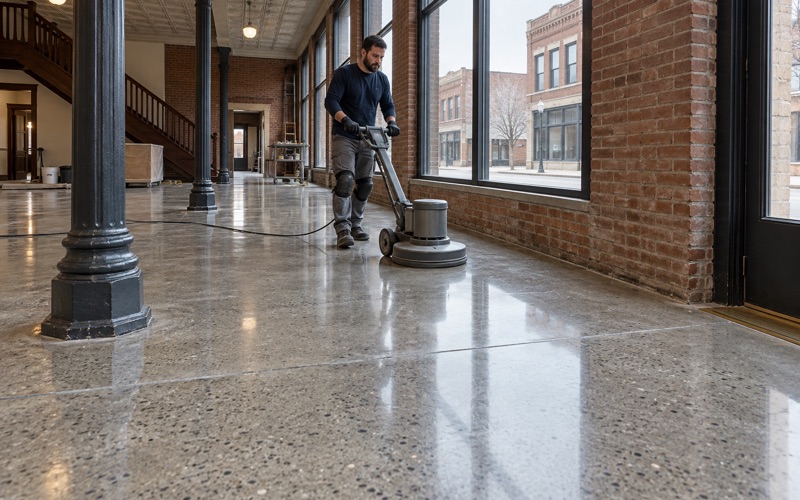
We open every slab with a diamond grinder or a shot blaster to a measured ICRI concrete surface profile, never an acid etch. Grinding dust is pulled into a vacuum at the machine instead of rinsed toward the floor drain or a grease interceptor.
Before the price is final, a moisture test goes into the written scope, using ASTM F1869 calcium chloride kits or ASTM F2170 in-situ probes. Cracks, spalls and old coatings get mapped first. When a slab needs repair or replacement before it should be coated, we say so instead of selling a floor that will lift.
Garages, Basements and Shops Around DeWitt
Houses, owners and the garage floor
DeWitt counted 5,514 people in the 2020 census, a 9.2% increase over 2000 that made it the fastest growing city in Clinton County. Census estimates put the city at 79.4 percent owner-occupied, with 1,536 owner-occupied detached houses, so a large share of our calls here come from homeowners.
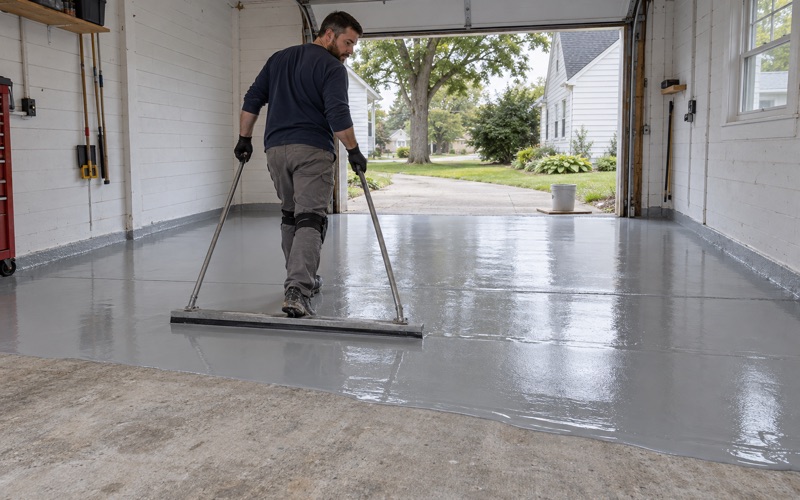
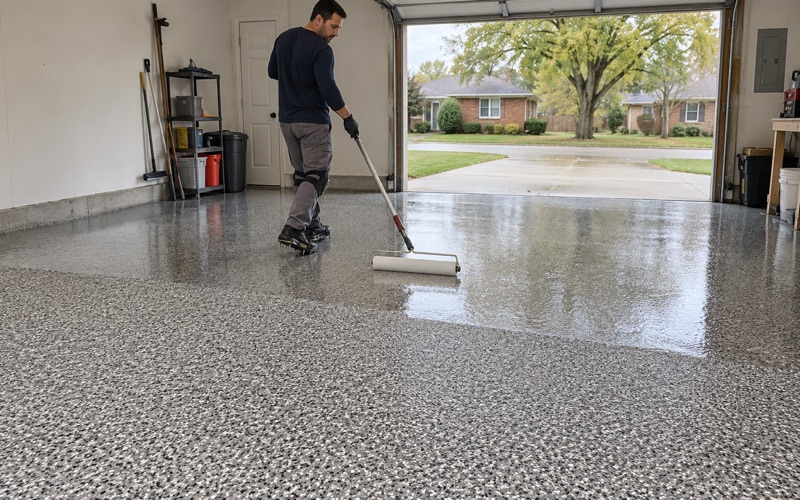
For a garage, that usually means a full-broadcast vinyl flake system over a 100% solids epoxy base, sealed with a polyaspartic topcoat that resists hot tire pickup. We size the system to the brine and rock salt that ride in on tires all winter, because calcium chloride left standing on a weak coating is what starts it peeling.
Older basement slabs and past water
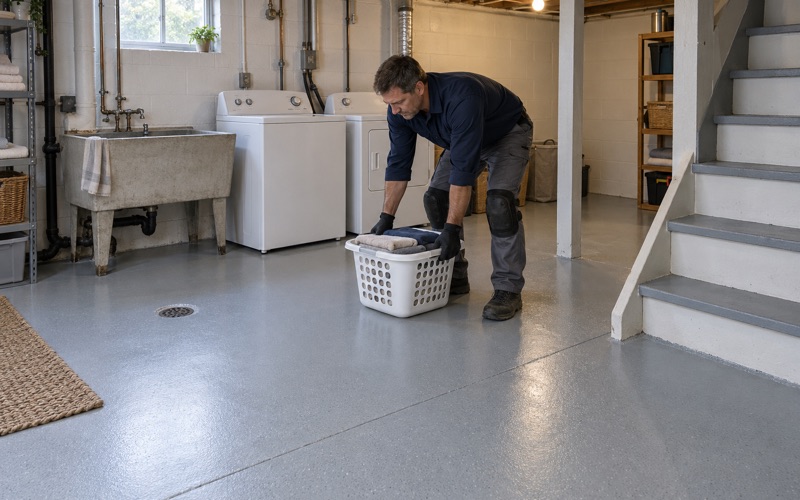
About 61.9 percent of DeWitt’s housing units were built before 1980, 1,425 of 2,302 by the Census count. An older basement floor gets read for past water before we quote it: we look for efflorescence and staining, check the floor drain, and open any sump pit.
A coating does not stop seepage, and we put that in writing. We never sell a floor coating as waterproofing or as radon work. Before a job is signed we also explain what the warranty leaves out, and moisture vapor transmission and hydrostatic pressure are the first exclusions we name.
Cold garages and cure timing
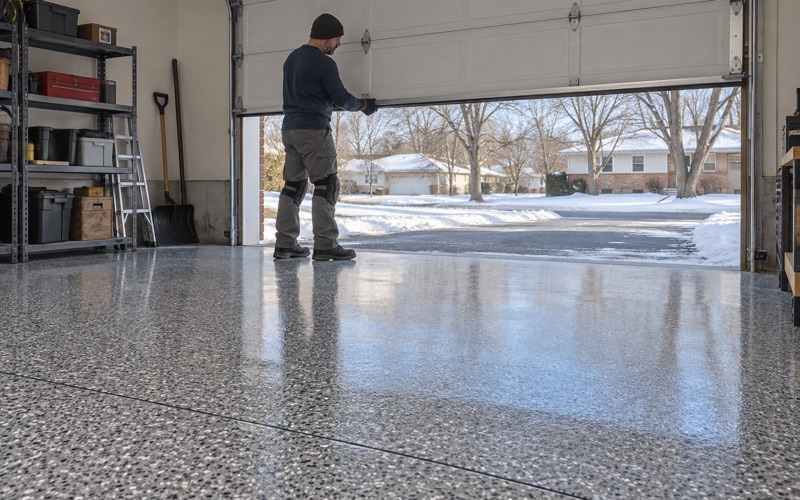
We schedule cure by slab temperature and the dew point spread at the surface, not by the calendar. Coating a cold slab when moisture can condense on it invites amine blush and a weak bond between coats.
An unheated DeWitt garage in a Quad Cities winter is told to wait for warmer weather, or to run steady heat ahead of the work. We would rather move a date than install a floor that clouds or peels by spring.
Plant and warehouse floors off Highway 30
Crossroads Business Park currently supports more than 12 industries and more than 1,000 jobs, and a project announced September 9, 2026 expands it by 149 acres. Shop floors there and across town take forklift traffic, dropped parts and spilled fluids that a garage never sees.
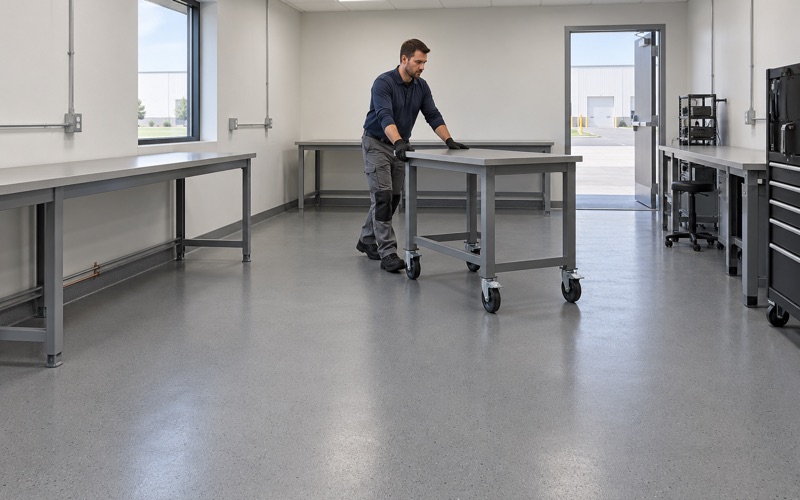
For those floors we phase the work around shifts, with overnight and weekend windows when a line cannot stop. Each phase is ground, primed and coated as its own section so the rest of the floor keeps running, and the proposal shows the order before the first machine is unloaded.
- 20+ Years on Concrete Floors
- Moisture Tested Before Pricing
- Diamond Ground, Never Acid Etched