Moline Epoxy Flooring brings more than 20 years of epoxy flooring work to Geneseo, Illinois, and one question shapes many of the shop quotes we write here: is there heat running through the slab? A floor warmed from inside behaves differently under fresh resin than a cold garage floor does. We plan the coating around that heat rather than pretending it is not there.
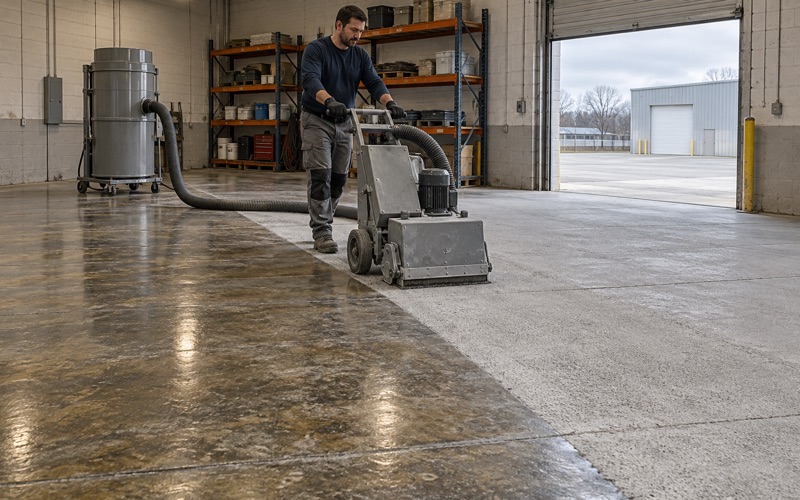
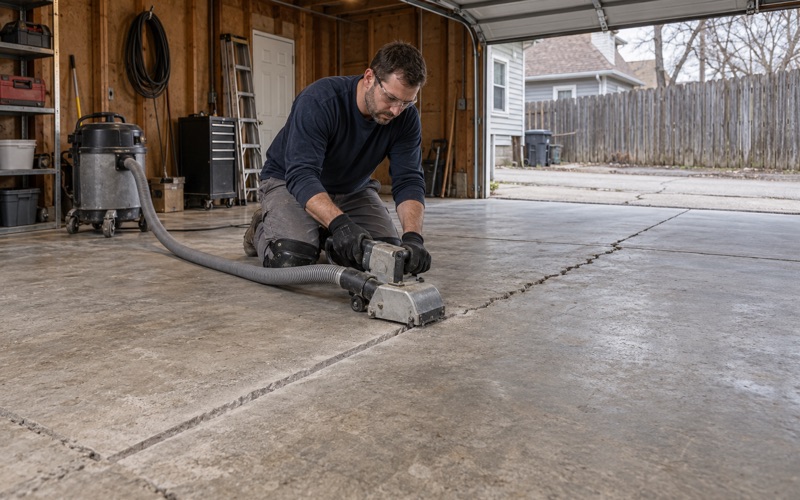
Every slab we coat is opened with a diamond grinder or a shot blaster, so the resin bonds to a real profile instead of a glazed surface. Before a price is final, the written scope includes a moisture test. Grinding dust is captured at the machine with a vacuum rather than washed toward a floor drain.
This page spends most of its time on heated shop slabs because that is where the schedule gets tricky. If your floor has no tubing in it, the same grinding, testing and written scope apply, just without a boiler on the calendar. Either way, we tell you up front when a slab needs repair before it should carry any coating.
Farm Shops and Heated Slabs in Henry County
A county that runs on cropland
Geneseo, Illinois sits in Henry County, about 20 miles east of the Quad Cities, where Interstate 80, U.S. Route 6 and Illinois Route 82 meet. The county around it is farm country. The 2022 Census of Agriculture counted 1,270 farms in Henry County, averaging 354 acres, with crops making up 87 percent of sales.
Equipment on that scale needs somewhere to be serviced, and much of that work happens in shops on the farm or near town. Seed corn is part of the local picture too, with Wyffels Hybrids keeping its research base in Geneseo. We treat a working shop floor as equipment in its own right, not a showroom surface.
Why some shop floors are warmed from below
NDSU Extension’s publication on heating farm shops, AE1620, revised January 2025, describes boiler-fed in-floor heat as a common choice. It notes that hydronic tubing can be placed in the concrete or in a sand bed below it, and that warm floors dry quickly. Anyone who has lain on a creeper over a cold slab understands the appeal.
We have not surveyed which Henry County shops use in-floor heat, so we never assume a given building has it. We ask, and we look for a manifold, a boiler or supply lines at the slab edge during the site visit. The answer changes the coating schedule more than almost anything else we find.
What we check first on a heated shop floor
Before any heated slab is quoted, we map its cracks, spalls and old coatings, because tubing in the concrete makes repair a more careful job. A crack over a tubing run is not something we chase with an aggressive saw cut. If a section needs repair or replacement before it should be coated, we say so in writing.
We also confirm whether the tubing sits in the slab itself or in sand below it, since that affects how deep any repair or anchor can safely go. Owners often have install drawings or photos from when the floor was poured. When they do not, we plan repairs around only what we can confirm.
Looking for epoxy-flooring closer to DeWitt? See Epoxy-Flooring Services in DeWitt.
Turning the Floor Heat Off Before Coating
What one maker’s data sheet asks for
Bostik’s HYTEC E570, a two-part epoxy damp proof membrane, is written for use over warm water underfloor heating. Its technical sheet says the heating must be switched off 48 hours before application, kept off during it, and left off for 48 hours after. That is one maker’s instruction for its own product, not a code requirement.
The product actually going onto your floor decides the numbers. Our proposal names the product line, the number of coats and the finished thickness, so the shutdown period comes from that system’s data sheet rather than from habit. If a different system calls for a different window, the schedule follows that sheet instead.
Why a warm slab works against fresh epoxy
Resin reacts faster on a warm surface, which shortens the working time a crew has to spread, back-roll and broadcast it. Uneven slab temperature can show up as uneven cure, with one zone still tacky while another has already set. Shutting the heat off ahead of time lets the slab settle toward room temperature before the first coat goes down.
Cure schedules here follow slab temperature and dew point, not the calendar. We read the slab surface itself and check the dew point spread, because a cooling floor in a humid shop can collect condensation that leaves amine blush on an epoxy coat. A shutdown that drops the slab too far is its own problem, so we watch both directions.
Planning the shutdown around a working season
A farm shop rarely has an empty week during planting or harvest, so we work out the heat-off window with the owner before the job is booked. Our crews phase shop floors around the work, including weekend windows when a building cannot sit idle for long. The goal is a schedule the shop can actually live with.
Turning off in-floor heat in deep winter also means the building gets cold. We talk through what else in the shop needs protecting from low temperatures while the boiler rests. Those decisions belong to the owner, but they belong in the plan rather than in a surprise phone call.
Bringing the Heat Back Slowly After the Cure
The gradual restart
The same Bostik sheet says to wait 48 hours after installation and then turn the underfloor heating up gradually, to prevent rapid dehydration. Jumping a boiler from off to full right after a coat cures works against exactly what that instruction protects. We write the restart into the schedule rather than leaving it to whoever walks past the thermostat first.
How gradual depends on the product, the slab and the season, and the data sheet for the installed system is the authority. We go over the steps with the owner on the last day, in plain terms. If your shop has a building manager or a hired boiler service, they get the same written note.
Who controls the boiler during the job
On a heated slab, the boiler is part of the job site. We agree in writing who turns it off, when, and who brings it back, so nobody restarts the heat halfway through a cure to keep the shop comfortable. A single line in the scope keeps that decision from being made on the fly.
We also note any zones on separate loops. A shop with an office or wash bay on its own circuit may need only part of the system shut down. The product sheet decides whether a warm zone is acceptable next to a freshly coated one.
Moisture testing on a warm floor
Heat moves moisture, so a heated slab gets the same moisture test in the written scope that every other floor we coat does. We choose between an ASTM F2170 in-situ relative humidity probe and ASTM F1869 calcium chloride testing based on the slab and what the product requires. The readings go to the owner with the quote.
Moisture is also the first exclusion we name when we explain a coating warranty. Warranties commonly leave out failures from moisture vapor transmission and hydrostatic pressure, and a heated slab does not change that. We walk through what is and is not covered before anyone signs.
Heavy Equipment, Warm Resin and Point Loads
What the indentation warning means
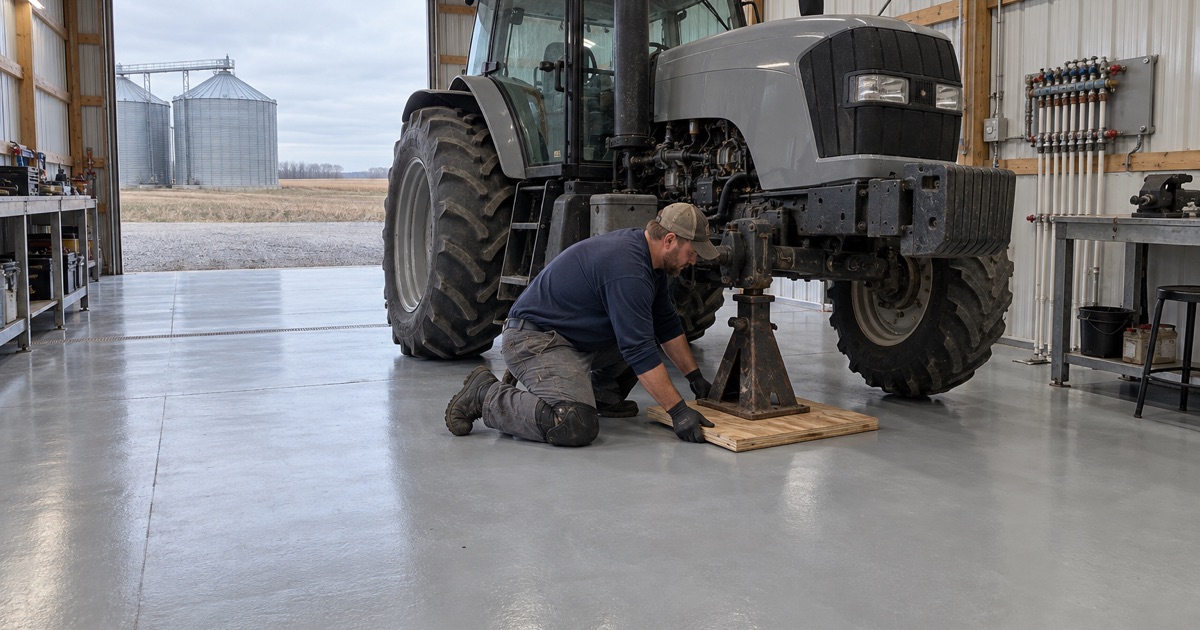
Sika’s MultiDur EB-14 data sheet carries a plain limitation: underfloor heating or high ambient temperatures, combined with high point loading, may lead to indentations in the resin. A jack stand, a loaded trailer tongue or a heavy machine resting on a narrow tire patch is exactly that kind of point load. Warm resin gives more than cold resin, and the load finds it.
Again, that is one maker’s warning for its own system, not a rule for every coating. It is still worth taking seriously on any floor where heat and heavy steel meet. We read the limitations section of every product we propose for a heated shop before it goes into a quote.
Choosing a system for weight and warmth
For a heated shop that carries machinery, we lean toward systems with real build, such as 100% solids epoxy with a quartz aggregate broadcast, or urethane cement where heat and abuse both run high. Because the finished thickness is in writing, you can check the floor against the quote after we leave. A slip-resistant texture comes from the broadcast and topcoat we specify, not from a slogan.
We also talk about how the shop actually uses its floor. Steel plates or wide pads under jack stands spread a point load, while parking the heaviest equipment in the same spot every winter concentrates it. Small habits like that matter more on a warm slab than on a cold one.
Garages and older homes in Geneseo
Not every Geneseo floor is a shop. Most housing units in town are detached and owner-occupied, and 24.7 percent were built in 1939 or earlier, so a basement here can carry a long history of water. We read an older basement floor for signs of past seepage, check the floor drain and any sump pit, and say plainly that a coating does not stop water.
Garage floors get a system chosen to stand up to the brine and rock salt that ride in on tires all winter. On the Illinois side we use floor coatings that meet the state’s VOC limits for the person applying them. Whether the floor is in a garage, a basement or a shop off Interstate 80, we never sell a coating as radon work or waterproofing, and we put that in writing.
- 20+ Years on Concrete Floors
- Moisture Tested Before Pricing
- Diamond Ground, Never Acid Etched