Moline Epoxy Flooring handles epoxy flooring in Milan with more than 20 years in the trade, and the floors we hear about most here carry forklifts, pallet jacks and parts carts every shift. The typical call starts with a painted aisle line that has worn to a ghost in the wheel paths, or a new racking layout that needs marking before it goes into service.
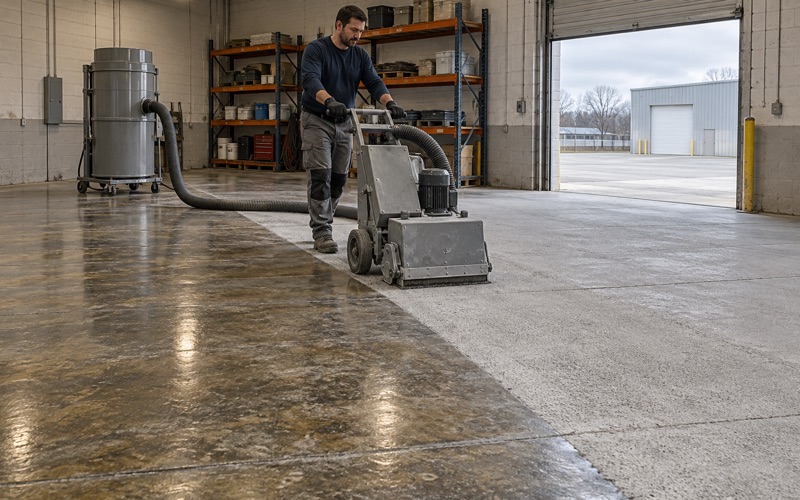
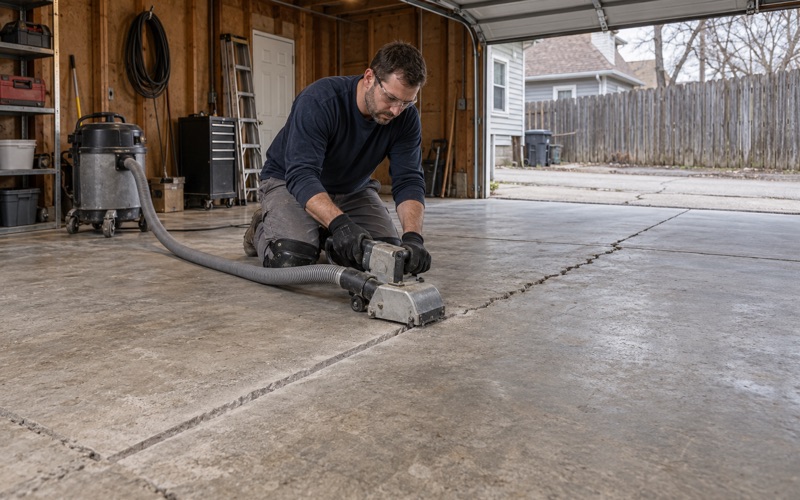
Our answer starts at the slab rather than the paint can. We open the concrete with a diamond grinder or a shot blaster, never an acid etch, and we map cracks, spalls and old coatings before we price anything. When a section needs repair before it should carry a coating or a line, the owner hears that from us first.
Each proposal names the product line, the number of coats and the finished thickness for the field coating and for the marking lines alike. A plant manager can hold the finished floor up against that page, which is a better test than a promise that the stripes will last.
A Parts Warehouse Beside the Airport

Milan sits in Rock Island County on the Rock River, about 4 miles upstream of the Mississippi, and its biggest floor is not in a house or a storefront. It is a warehouse, and that frames how we think about floor work here.
The John Deere North American Parts Distribution Center
The John Deere North American Parts Distribution Center is described by the Center for Land Use Interpretation as located next to the airport, with a warehouse of 2,800,000 square feet. Deere lists the Milan center as its primary North American parts operation, running since 1973 with about 1,200 employees, and it is often described as one of the largest warehouses in the world.
We want to be plain about our place in that picture: we have never worked for John Deere, we do not coat or mark that building, and we do not know how its aisles are marked. We bring it up because the federal rule that governs aisle marking reaches a floor that size and a single-bay parts room alike, as long as powered handling equipment runs on it.
A Village That Has Always Moved Goods
Milan was first platted in 1837 along the Hennepin Canal right-of-way under the speculation name Hampton, and by 1841 it was known as Camden Mills, with wool carding and pearl buttons in its history. Eagle Food Centers kept its base in the village until 2003. Distribution and light industry are not new here, and neither are the concrete floors that carry them.
That kind of floor history matters to us. An older slab may carry several layers of earlier paint or coating, and a newer pour may never have been sealed at all. Both can hold a durable marking line, but they need different preparation, and the difference is settled before the first line is snapped.
Working Around Shifts
An industrial floor usually cannot close for a week. We phase shop, plant and warehouse work around production, taking overnight and weekend windows when a line cannot stop, and we sequence the aisles so that traffic can reroute while one section grinds, coats and cures.
Grinding dust is captured at the machine by a vacuum rather than washed toward a floor drain or a storm inlet, which matters in a working building where people and stock stay on the other side of a barrier. Each phase gets a written reopening time, so the floor manager can plan the move of stock and equipment around it.
Looking for epoxy-flooring closer to Rock Island? See Rock Island Epoxy-Flooring.
What OSHA 1910.176(a) Asks of a Warehouse Aisle
The Text of the Rule
Federal OSHA’s materials-handling standard, 29 CFR 1910.176(a), applies wherever mechanical handling equipment is used. It requires sufficient safe clearances for aisles, at loading docks, through doorways and wherever turns or passage must be made. It also says aisles and passageways shall be kept clear and in good repair, and that permanent aisles and passageways shall be appropriately marked.
That duty sits with the employer running the facility, not with the flooring contractor. Our part is narrower: when an owner decides that painted or coated lines are how their aisles will be marked, our job is to bond those lines to the slab well enough to still be there at the next walk-through. Paragraph (e) of the same section separately calls for clearance signs to warn of clearance limits.
A Rule That Leaves the Method Open
The phrase does not name a method. A March 1977 South Carolina OSHA program directive interpreting 1910.176(a) put it directly: the intent of “appropriately marked” is not to restrict the marking to one method only. It listed storage bins, marking pillars, flags, cones or barrels as acceptable where employee training covers them, and Oregon OSHA’s Program Directive A-54, revised in 2018, takes the same view.
The same 1977 directive added that painted lines remain the most feasible method of marking, where practical, since they may last several years without maintenance or repainting. The words that matter to us are “may” and “where practical.” A line lasts years only when the floor under it was prepared to hold it, and that is a coating decision before it is a safety one.
Line Width, Color and What the Rule Does Not Say
The rule text sets no stripe width and no color. Secondary sources report a May 1972 federal OSHA interpretation that treated an aisle line at least 2 inches wide as appropriately marked, recommended 2 to 6 inches, and accepted any color, in continuous lines or in dots and squares. That interpretation is reported rather than something we have read, and it is guidance, not the rule.
So we never describe a stripe as approved or certified by OSHA; the rule text gives nothing to certify against. The width, color and pattern come from the employer’s own safety plan and the traffic it describes, whether that means one color for pedestrian lanes and another for forklift aisles or one color throughout. We lay out what the plan calls for and write it into the proposal.
Why Marking Lines Are a Floor-Coating Question
Wheel Paths Wear a Sprayed Stripe First
A forklift does not spread its wear evenly across an aisle. It runs the same tracks shift after shift, and a line sprayed onto bare or dusty concrete sits on the surface with little to grip. Those wheel paths are where a stripe fades first.
A line that has worn away is no longer marking anything. An aisle edge that has broken into fragments in the wheel paths leaves the floor reading as open concrete, which is the condition the marking requirement is there to avoid. Restriping over the same unprepared surface just restarts the same clock.
Grinding and Priming Under the Line
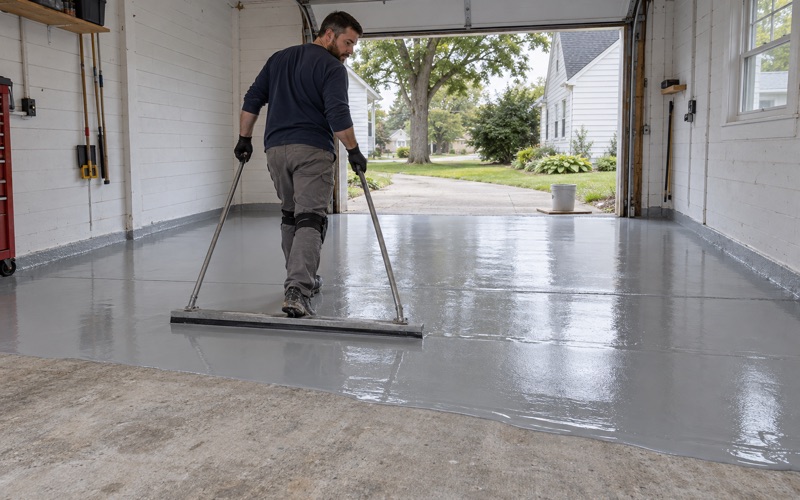
We grind or shot blast the line path to the ICRI concrete surface profile the product calls for, vacuum it, and prime it before the line goes down. The line itself is a coating, typically a 100% solids epoxy or a polyaspartic, built to a stated thickness rather than misted on. On a floor getting a full field coat, the lines go in as part of that system.
Because the slab is profiled rather than acid etched, the coating has something real to bond to, and amine blush on an epoxy line is cleared before any topcoat goes over it. Where an aisle crosses a wet or slick zone, a quartz aggregate broadcast under the topcoat gives a slip-resistant texture that is specified by the materials, not promised as a slogan.
Testing the Slab Before the Lines Go Down
A moisture test is written into the scope before the price is final. Depending on the slab, that means ASTM F2170 in-situ relative humidity probes or ASTM F1869 calcium chloride testing, with a quick ASTM D4263 plastic sheet check as a first read. Moisture coming up through a slab is one of the most common reasons a coating or a line lets go.
That is also why moisture is the first exclusion we name when we explain what a coating warranty leaves out, and we do it before the job is sold. If the readings come back high, a moisture-mitigation primer goes into the proposal as its own line item, or we say plainly that the floor should wait.
Smaller Shops, Kitchens and Garages Around Milan
Not every working floor in Milan is measured in millions of square feet, and the aisle rule follows any building that runs powered handling equipment. The other floors here bring their own authorities and their own failure points.
Shops and Small Warehouses
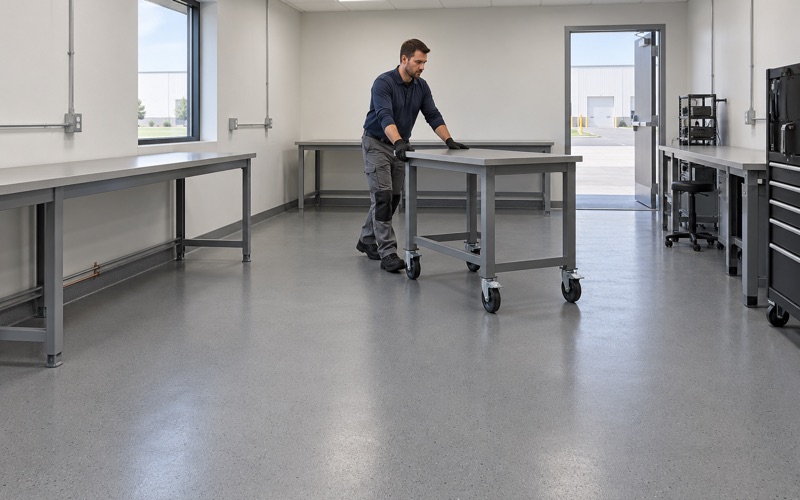
A small warehouse or contractor’s shop often has an older coating already down, peeling in the traffic lanes and holding firm under the racks. We map where it is failing and where it is sound, then grind the failing material off rather than coating over it, because a new line bonded to a loose old film comes up with it.
On the Illinois side, every floor coating we apply meets the state’s VOC limits under 35 Ill. Adm. Code Part 223, which binds whoever applies or solicits application of the coating. In an occupied shop, ventilation and re-entry timing are planned with the staff in the next bay in mind.
Food-Service Floors and the County Health Department
Restaurant and grocery floors in Milan answer to the Rock Island County Health Department, which inspects in all areas of the county that do not have a local health department. The village has no inspector of its own, so a kitchen here is planned around the county’s review.
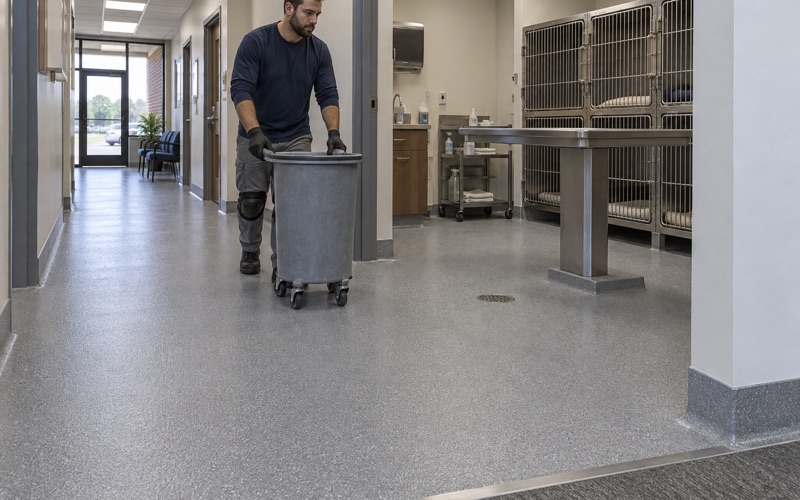
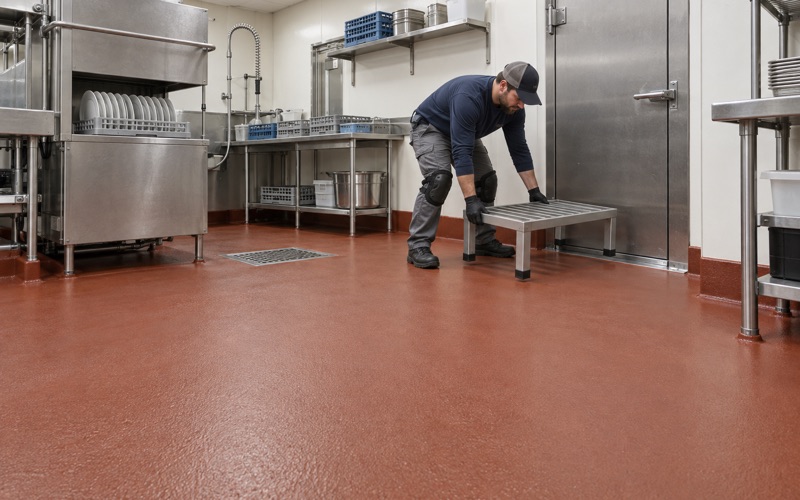
We specify coved bases where the floor meets the wall and a texture chosen for the wet areas, and we flag grease interceptor locations before grinding starts so dust stays out of them. The finish is urethane cement or a textured epoxy system, named in the proposal, depending on the heat and washdown the kitchen sees.
Postwar Garages and the Village Permit
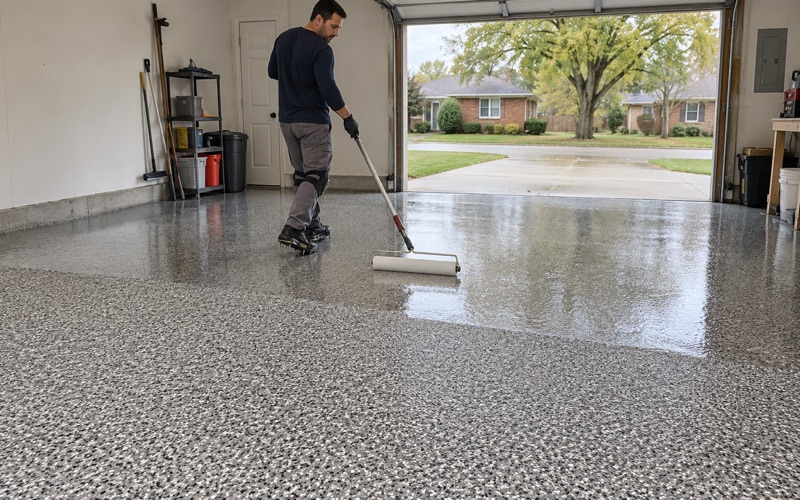
Milan’s housing is 66.0 percent owner-occupied and 62.2 percent detached houses, and 69.1 percent of units were built in the 1950s through the 1970s. Garage slabs of that age have often seen decades of rock salt and brine, so we read them for freeze-thaw scaling before choosing a system built to hold up to the deicers that ride in on tires every winter.
We tell the owner of an unheated garage to wait through a Quad Cities winter until the slab temperature and dew point spread allow a proper cure. Larger work that needs a building permit goes through the village, which requires contractors to register, carry a continuous $10,000 bond and show liability and workers’ compensation coverage; we confirm that step with the village for each job that triggers it.
- 20+ Years on Concrete Floors
- Moisture Tested Before Pricing
- Diamond Ground, Never Acid Etched