Moline Epoxy Flooring applies polyaspartic floor coating systems in Moline, IL, serving surrounding cities including Silvis, Milan, Rock Island, Campbell’s Island and Bettendorf. Over 20 years, we have learned that the fastest-curing coating on the market still depends on the slab under it, so every polyaspartic job starts with grinding and a moisture test.
Polyaspartic is a fast-curing coating that resists ultraviolet yellowing and stands up to abrasion and many chemicals. It is popular for garages that need to be back in service quickly and for commercial floors that cannot be closed for long.
That speed has a cost if it is misused. A coating that cures in minutes gives the installer little time to work, and a fast cure on a poorly prepared slab simply locks in the problem sooner. Our proposals name the product, the number of coats and the finished thickness so you can see what the speed is built on.
What Polyaspartic Is and Where It Fits
A Faster Cure Than Epoxy
Polyaspartic coatings belong to the polyurea family, and they cure much faster than epoxy. On a well-prepared floor that can mean walking on it the same day and driving on it sooner than with an all-epoxy system.
The short working time means the coating has to be mixed in small batches and applied by a crew that knows exactly where it is going next. That is installer skill, not a product feature, and it is what separates a smooth floor from one full of lap marks.
Holding Color in Sunlight
Many epoxies amber, or turn yellow, when sunlight reaches them. Aliphatic polyaspartic coatings resist that change, which is why they are the usual topcoat on garages with doors that stay open and on storefronts and showrooms with a lot of glass.
If you are choosing a light flake blend or a solid gray, a UV-stable topcoat is the difference between the color you picked and the color you see a few years later.
Wider Temperature Range at Application
Polyaspartic can often be applied at lower temperatures than standard epoxy. That gives us more flexibility in spring and fall, but it does not make cold-weather coating automatic.
We still read the slab temperature and the dew point spread at the surface. If moisture is condensing on a cold slab, no coating bonds well, and an unheated garage in deep winter is still a job we recommend holding.
Residential and Commercial Polyaspartic Floors
Garage Floors at Home
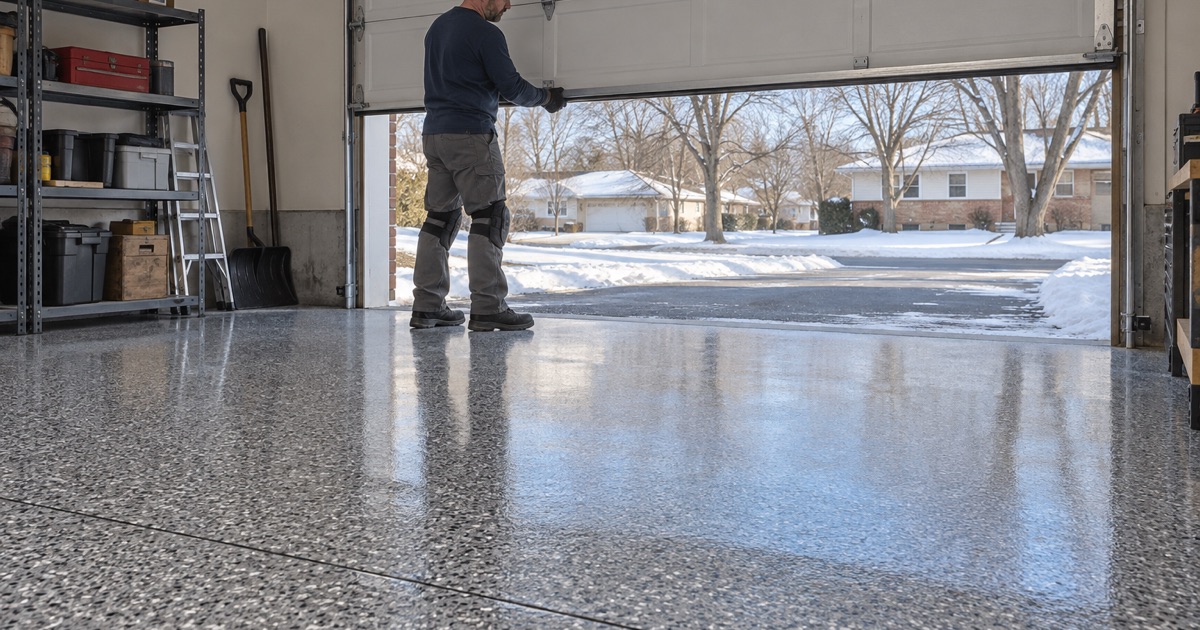
In a home garage, polyaspartic is most often used as the clear topcoat over a flake broadcast. It handles the hot tire pickup that ruins thin coatings and resists the rock salt and calcium chloride brine that come in on tires all winter. We choose the garage system for that full year of use, with a texture that gives grip under snowmelt without being hard to sweep.
Basements and Workshops
In basements and home workshops, the quick cure means less time with the space out of use. The moisture question still comes first, because basement slabs can push vapor up from below, and no fast-curing topcoat changes that. We read older basement floors for past water, check the floor drain and any sump pit and tell you in writing that a coating is not waterproofing.
Storefronts, Showrooms and Service Bays
For businesses, the main appeal is downtime. A storefront, showroom or service bay can often be coated over a weekend or in overnight sections, and back in use with little lost trading time.
We phase commercial work around your hours and capture grinding dust at the machine with a vacuum, so it never ends up rinsed toward a floor drain or a storm inlet.
Shops and Light Industrial Floors
In a working shop, polyaspartic is valued as a tough, chemical-resistant topcoat over a thicker epoxy base. It handles oil, coolant and dropped parts while letting a section of floor return to service quickly between shifts.
Where a floor sees hot water washdowns or heavy impact every day, we may recommend urethane cement or a thicker system instead. Choosing the right material for the use matters more than the speed of the cure.
Our Step-by-Step Polyaspartic Floor Coating Process
Step 1: Slab Assessment and Moisture Test
We walk the floor, map cracks, spalls and old coatings, and test for moisture using the ASTM D4263 plastic sheet test or ASTM F1869 calcium chloride and ASTM F2170 relative humidity methods where a number is needed. The result goes into the written scope before the price is final.
This is also when we look at what the floor is used for and how it is cleaned. A garage that sees road salt, a showroom that sees sunlight and a service bay that sees hydraulic fluid each point to a different system, and we pick it before grinding starts.
Step 2: Diamond Grinding or Shot Blasting
The slab is opened with a diamond grinder or a shot blaster to a concrete surface profile matched to the system, using the ICRI CSP scale as the reference. We never acid etch, because an etched surface gives a fast-curing coating nothing reliable to grip.
The grinders and blasters run with vacuums attached, so dust is collected at the machine. On an attached garage or an occupied store, we also close off the work area before the first pass.
Step 3: Repairs
Cracks and spalls are filled and ground flush, joints are addressed and any remaining weak spots are cut out. This is the step that keeps damage from showing through the finished floor.
If the mapping turns up damage that is too widespread to patch, such as a heaved or crumbling slab, we stop and tell you. Coating a slab that needs replacing is money spent on a floor that will crack again.
Step 4: Base Coat and Broadcast
A base coat goes down, often a 100% solids epoxy or a pigmented polyaspartic, followed by a vinyl flake or quartz aggregate broadcast if the system calls for one. Excess material is scraped and vacuumed after it cures.
The broadcast sets the look and much of the grip. Full flake coverage hides more dust and wear, while a partial broadcast shows more of the base color and gives a lighter texture.
Step 5: Polyaspartic Topcoat
The clear or tinted polyaspartic topcoat seals the system. Texture additives can go into this coat for a more slip-resistant finish where wet shoes or snowmelt are expected.
Before we leave, you get the walk-on and drive-on times in writing, along with care instructions. Those times follow the slab temperature on the day, so we adjust them if the floor ran cooler than planned.
Rules, Warranties and What to Expect
VOC Rules on Each Side of the River
In Illinois, 35 Ill. Adm. Code Part 223 limits the VOC content of floor coatings, and the rule applies to whoever puts the coating down, so every Illinois job uses a compliant product. On the Iowa side, the federal 40 CFR 59 Subpart D rule governs manufacturers, and choosing a low-odor product there is about comfort and re-entry.
What a Warranty Does Not Cover
Coating warranties commonly exclude moisture vapor transmission and hydrostatic pressure from below. We explain those exclusions before the job is sold, because they are the conditions most likely to push any coating off a slab.
That is also why the moisture test sits at the front of every job. A fast-curing topcoat does not change what moisture does from below, and a warranty that excludes it is only as useful as the testing done before the coating went down.
Not a Shortcut on Preparation
A fast cure saves time on the coating, not on the preparation. The grinding, repairs and moisture testing take the same care with polyaspartic as with any other system, and we schedule the job so none of that is rushed.
- 20+ Years on Concrete Floors
- Moisture Tested Before Pricing
- Diamond Ground, Never Acid Etched