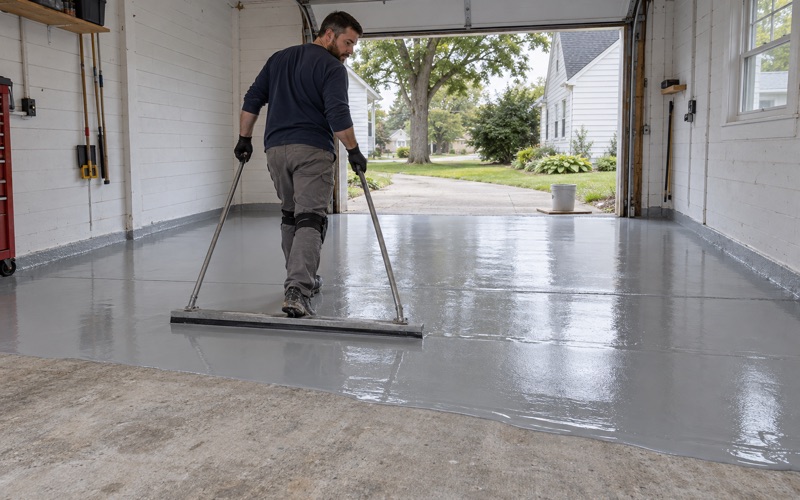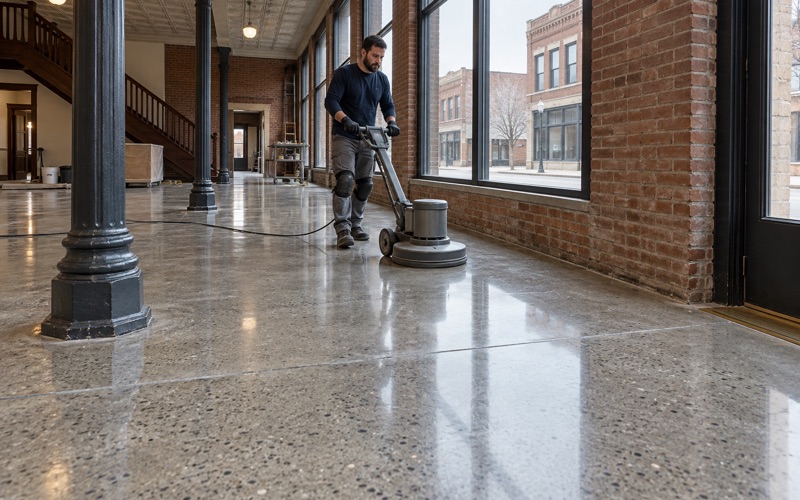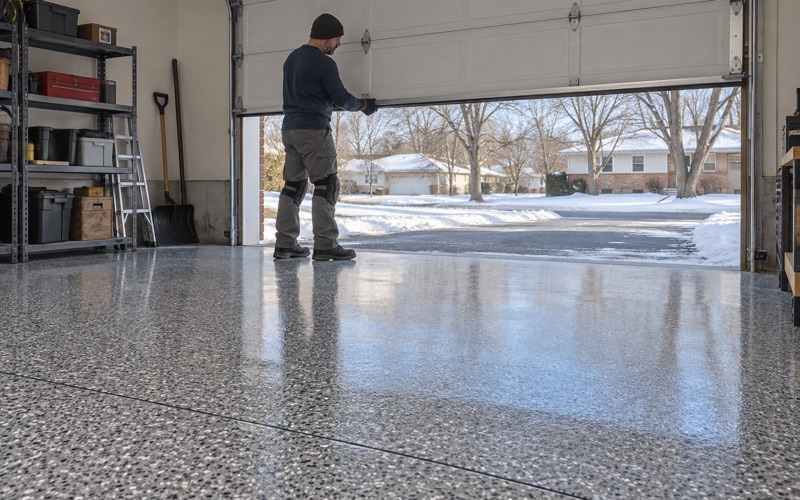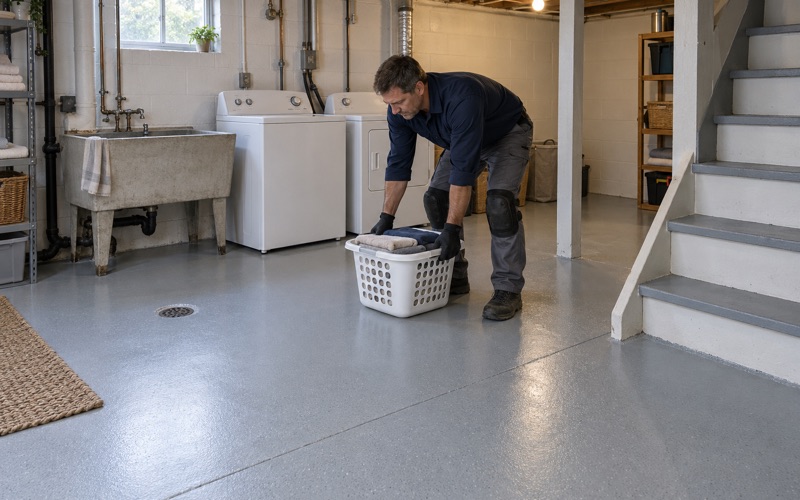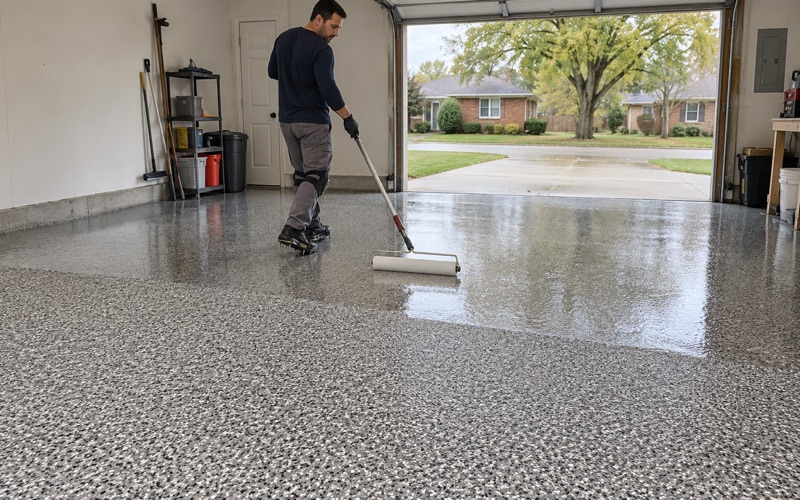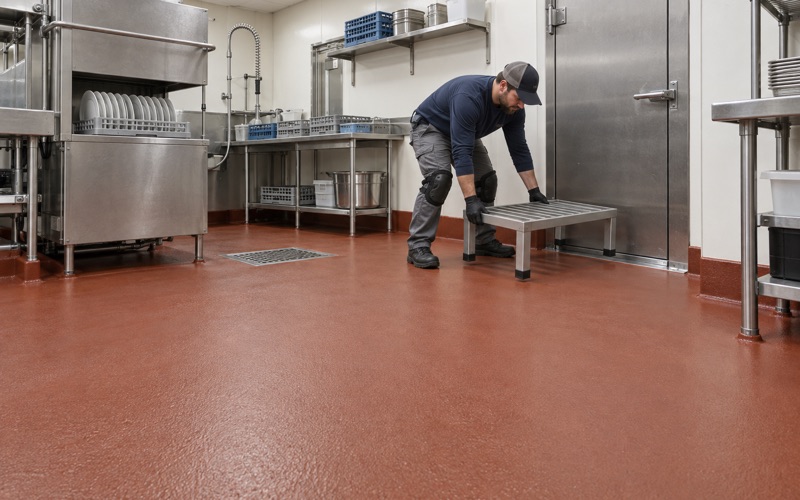
Moline Epoxy Flooring brings more than 20 years of epoxy flooring work to Rock Island, and on a bright floor the first question we ask is what the light will do to it. A garage or a basement sees almost no sun, so the coating there is chosen for tires, grip and moisture. A room with a skylight or a wall of glass is a different job, because the color of every layer has to be planned for the light that lands on it each day.
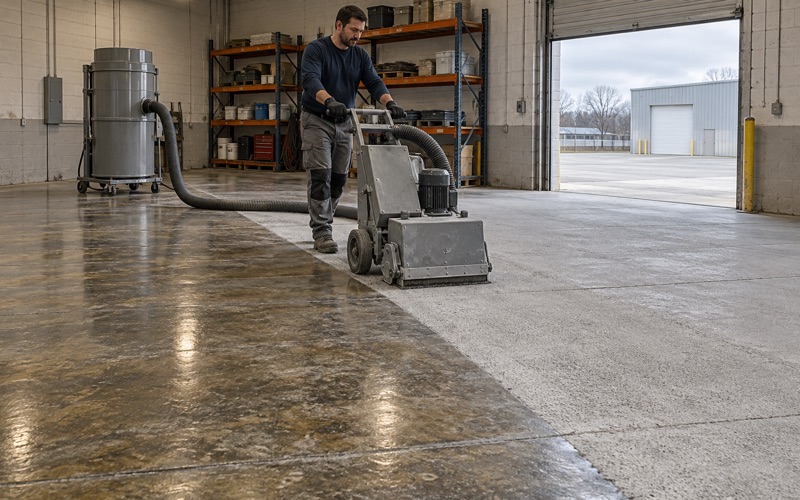
That planning starts the same way on every slab. We open the concrete with a diamond grinder or a shot blaster, never an acid etch, and a moisture test is written into the scope before the price is final. The proposal then names the product line, the number of coats and the finished thickness, so you can hold the finished floor up against the quote.
On a sunny room the proposal says one more thing in plain words: which layers are expected to shift color in sunlight and which are built to resist it. Nobody should have to learn that from the floor itself a year after the crew has left.
A Glass Garden on 4th Avenue and What Sunlight Does to Epoxy
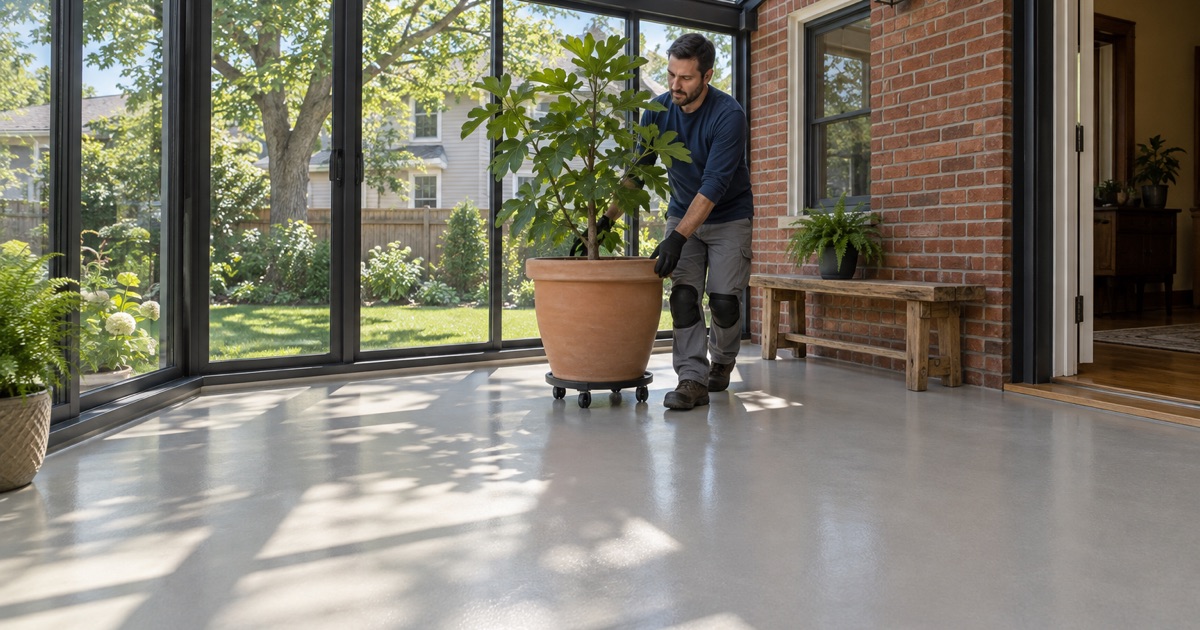
A room built to let the sun in
The Quad City Botanical Center at 2525 4th Avenue keeps its Sun Garden under a 70-foot skylight, with the indoor pond divided from the outdoor one only by a glass atrium wall. The center describes the garden as 6,444 square feet of climate-controlled space, and it grows coconut, banana, vanilla, coffee and cocoa there. Every decision in that room serves one purpose, which is getting sunlight to the plants.
We point to it because it is the clearest example in Rock Island of a room designed around daylight. We have no connection to the center and have not seen what its floors are made of. What it shows is the condition, and that same condition turns up at a smaller scale in sunrooms, skylit lobbies and glass storefronts across the city.
Why the color moves
Most epoxy base coats are built on aromatic resin, commonly bisphenol-A chemistry. The aromatic rings in that resin react with ultraviolet light, and the slow photo-oxidation that follows is what turns a clear coat amber and a pigmented coat duller or yellower. It is a property of the chemistry, not a sign of a careless installation.
The manufacturers say so in their own documents. Sika’s product data sheet for Sikafloor-264, a pigmented two-part epoxy, dated September 2026, states that the product will discolor over time when exposed to sunlight and under certain artificial lighting conditions.
What the label on a kit tells you
Retail kits are blunter about it. The instructions for the Gorilla Garage Floor Coating Kit, a two-part 100% solids epoxy, say the product is intended for interior concrete only and should not be used in areas exposed to direct sunlight. That warning is aimed at someone rolling out a kit on a Saturday, but the chemistry behind it is the same one inside many commercial systems.
When a homeowner shows us a kit they bought for a sunroom, we read that line together before anything gets mixed. Occasionally the kit still has a place in a shaded corner, but most of the time the room needs a different top layer and a different base color.
Looking for epoxy-flooring closer to Campbell’s Island? See Epoxy-Flooring in Campbell’s Island.
What a UV-Resistant Topcoat Can and Cannot Protect
The top layer does the visible work
The usual answer to sunlight is a clear topcoat made from an aliphatic chemistry, such as a polyaspartic or an aliphatic urethane. Aliphatic resins lack the aromatic rings that react with ultraviolet light, so the topcoat itself holds its clarity and gloss far better than an epoxy layer would in the same sun. On a sunlit floor we nearly always specify one.
That topcoat also carries the wear. It takes the foot traffic, the chair legs and the cleaning, which keeps the scratch pattern in a layer that can be screened and recoated later without disturbing the epoxy underneath.
Where the protection stops
Here the data sheet matters again. Sika’s limitation for Sikafloor-264 goes on to say that use of a clear UV resistant top coat may not prevent discoloration of underlying coatings. A clear topcoat is clear, which means light still reaches the epoxy beneath it, and the base can shift even while the top layer stays bright.
So we do not promise a floor that never yellows, and we would be wary of anyone who does. What we can do is choose a system where any shift in the base coat is small, even and hard to see, then tell you in writing which layers are expected to change.
Reading the warranty for sunlight
We explain what a coating warranty leaves out before the job is sold, and moisture is the first exclusion we name. On a sunny floor the second is color change in the base coats under ultraviolet light. Hearing that ahead of time turns a future surprise into a choice you made with the facts in front of you.
The same honesty covers what a coating is not. A floor coating is never radon work or waterproofing, and we put that in writing on every job, sunroom included.
Choosing Colors and Top Layers for Sunlit Rooms
Colors that age gracefully
Color choice is the strongest tool we have in a bright room. A bright white or a pale pastel base shows the faintest amber cast, while a warm tan, a mid gray or a darker earth tone absorbs the same shift and still looks like the sample. A vinyl flake broadcast in several tones also breaks up any change across the floor.
We bring samples into the room itself and look at them when the sun is strongest. A chip that reads cool gray under shop lights can look quite different on a floor beside a south-facing window at two in the afternoon.
Building the system for the light
In a sunroom the build usually runs a primer, a pigmented 100% solids epoxy body coat, an optional flake or quartz aggregate broadcast, and an aliphatic topcoat sealing the whole floor. Some rooms are better served by a full polyaspartic system with no aromatic epoxy layer near the surface at all. The proposal names which build we chose and why.
Topcoat thickness and the number of coats matter as much as the product name. A single thin coat over a large sunny floor wears through in the traffic lanes, and once the topcoat is gone the epoxy beneath sees the full sun. We spell out the coats so the finished floor can be measured against the quote.
Partial sun is its own problem
Uneven light can be harder on a floor than full light. A room that is half in the sun and half under a roof overhang can age into two tones, and a rug or a planter that sits in one spot for years leaves a lighter footprint when it is finally moved. We walk the room with you to see where the sun lands across the day and plan the colors around the brightest spot.
Rooms with strong artificial lighting deserve the same caution. Sika’s own limitation names certain artificial lighting conditions alongside sunlight, so a brightly lit showroom gets the same color conversation as a glass porch.
Sunrooms, Skylit Lobbies and Storefront Windows in Rock Island
Sunrooms and enclosed porches at home
Rock Island is largely a city of houses. Census estimates count 9,281 owner-occupied detached homes, and 5,398 of the city’s housing units were built in 1939 or earlier. When one of those houses has a sunroom, an enclosed porch or a bright back addition, that room gets a different system than the basement below it.
Before any coating goes down, we map cracks, spalls and old coatings across the slab, and we tell you when a slab needs repair or replacement before it should be coated. Older porch floors often carry a layer or two of paint, and none of it is left under a new floor.
Lobbies, offices and showrooms
A skylit lobby or a glass-fronted office sees sun on the same patch of floor for hours at a time. In those spaces we lean on a darker or multi-tone base and a full aliphatic topcoat, and we phase the work around business hours, with overnight and weekend windows when the doors cannot close.
Grinding dust on these jobs is captured at the machine with a vacuum, which matters in an occupied building. Nothing is rinsed toward a floor drain or out the front door, and on the Illinois side we use floor coatings that meet the state’s VOC limits for the person applying them.
Storefront windows and the first ten feet
A storefront takes its strongest light just inside the glass, in the strip customers cross first. That is where a color shift shows most, so we sometimes run a darker border or a denser flake blend along the window line. The rest of the floor can then carry a lighter color without the entry aging ahead of it.
If you have a room with a skylight, a glass wall or a long run of windows, send us a photo taken at midday. We will tell you plainly which part of the floor will see the most sun and what we would build there.
- 20+ Years on Concrete Floors
- Moisture Tested Before Pricing
- Diamond Ground, Never Acid Etched