Moline Epoxy Flooring has spent more than 20 years putting down epoxy flooring in Silvis and across the Illinois side of the Quad Cities, and on a big winter job the first question we ask is not which flake color to pick. It is how the building will be kept warm while the resin cures. A cold slab stretches a cure, and the wrong source of heat can mark a finish that was mixed and rolled perfectly.
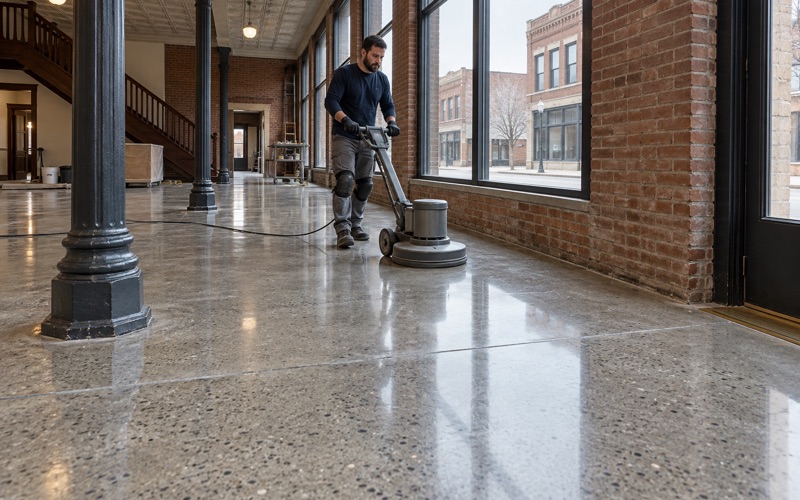
Our scope starts with the concrete itself. We open every slab with a diamond grinder or a shot blaster rather than an acid etch, we write a moisture test into the scope before the price is final, and our proposal names the product line, the coat count and the finished thickness. On a large shop floor we add one more line item: the temporary heat plan, with the heater type spelled out.
This page is about that heat plan. It covers why the heater matters to the chemistry, what one manufacturer’s system sheet says about fossil fuel heaters and electric warm air, and how we phase a floor in a building too large to finish in one push.
A Century-Old Locomotive Shop Gets a Second Life
The Silvis Shops and the Rock Island Line
The Rock Island Line chose Silvis in 1902 for its largest locomotive repair shop, and construction began on May 1, 1903, on a 900-acre site with a 45-stall roundhouse and a 90-foot turntable. The complex, long known as the Silvis Shops, shaped the city around it, including La Yarda, the community Mexican immigrant workers formed near the yards. Our Lady of Guadalupe church there was dedicated in 1927.
Hero Street, named in 1967, and Hero Street Park, dedicated on October 30, 1971, belong to that same story. We mention the history because it explains the buildings: shops designed for steam locomotives were built big, open and tall, and any coating job in a building of that scale behaves differently from one in a two-car garage.
Railroading Heritage of Midwest America Moves In
Railroading Heritage of Midwest America, a Minneapolis-based nonprofit, announced in January 2022 that its subsidiary Friends of the 261 would expand into the former National Railway Equipment complex. The site covers 90 acres, and in the organization’s own words, the main shop building is 400,000 square feet with multiple overhead cranes, alongside a wheel shop, warehouse space and several smaller shop buildings.
Its plans named restoration, diesel and passenger car repair, historic preservation and a future transportation museum. Union Pacific Challenger No. 3985 is being restored there, according to the Quad Cities Business Journal in November 2025, and the site at 1101 Second Ave. sits inside Silvis city limits.
A New Roundhouse and a 135-Foot Turntable
The same report described a new multi-stall roundhouse and a 135-foot turntable donated by BNSF, placed near the original’s location, with a total estimated cost of 15 million dollars. The turntable could be complete by summer 2027, and the roundhouse is meant to work as a living museum with tours during special events and open houses.
We have never worked on this complex, and we do not know how it is heated or what its floors are made of. We use it here because it is the clearest local picture of the kind of building where heating becomes a flooring decision: a huge volume of air, high ceilings and a great deal of floor to keep warm at once.
Looking for epoxy-flooring closer to Milan? See Epoxy-Flooring Services in Milan.
Why a Cold Shop Needs a Heating Plan Before a Coating Plan
Slab Temperature, Not Air Temperature
Epoxy cures through a chemical reaction, and that reaction slows as the concrete cools. In a tall building, a few hours of heat can warm the air near the roof long before the slab underneath catches up, so a thermometer at eye level tells us little. We read the slab surface at several points and schedule from those numbers, never from the calendar.
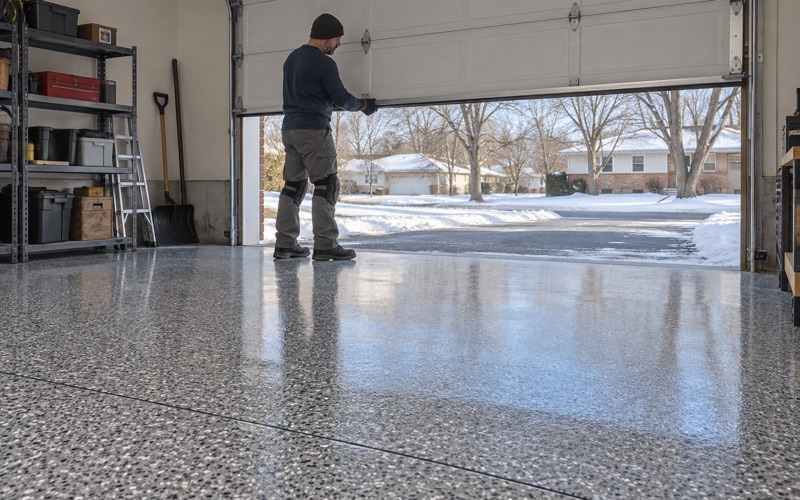
That is the same rule we give a homeowner with an unheated Quad Cities garage in January: if the slab cannot be held warm enough through the cure, the job waits. A big shop only changes how much heat it takes to get there and how long the heat has to run before the first coat goes down.
What the Heater Adds to the Air
Every heater changes a room in two ways. It raises the temperature, and depending on the fuel, it adds combustion products. An open-flame heater burning propane, kerosene or natural gas releases carbon dioxide and water vapor straight into the space where the coating is curing, and in a closed-up building those gases drift across the wet floor.
That is why our proposal for a cold-weather shop job states the heat source in writing. If the building owner plans to supply heat, we want to know what kind before the first batch is mixed, because swapping heaters halfway through a cure is too late to help.
Moisture in the Slab Still Comes First
A heating plan does not replace a moisture test. We run ASTM F2170 in-situ relative humidity probes or ASTM F1869 calcium chloride tests as the slab calls for, and the readings mean the most once the space has been brought to the conditions it will be coated in.
Cracks, spalls and old coatings get mapped at the same visit. When a slab needs repair or replacement before it should be coated, we say so plainly, because no heater and no primer turns a failing slab into a sound one.
Fossil Fuel Heaters, Carbon Dioxide and the Finish
What One System Data Sheet Says
Sika’s data sheet for its Sikafloor MultiDur EB-14 system, a slip-resistant epoxy system meant for workshops, garages, storage areas and production floors, is unusually direct about heat. Its limitations section says that if temporary heating is required, do not use gas, oil, paraffin or other fossil fuel heaters, because they produce large quantities of carbon dioxide and water vapor that may adversely affect the finish. For heating, it says to use only electric powered warm air blower systems.
Paraffin is the British name for kerosene, so in American terms that line reaches propane torpedo heaters, kerosene units and gas-fired heaters alike. The instruction is about the fuel being burned inside the room, not about the brand of heater.
Why a Curing Finish Reacts to Combustion Gases
This part is general coatings knowledge rather than a line from the sheet. Fresh epoxy is sensitive while it cures, and moisture and carbon dioxide at the surface can react with the curing agent and leave amine blush, a waxy film that can cloud a clear coat, dull a gloss and weaken the bond of the next coat if it is not cleaned off.
A floor that looked flawless when the last roller pass ended can come back blotchy the next morning. When we find blush, we remove it before recoating, which costs a day. Avoiding the cause is cheaper, and in a cold building the heater is one cause we can actually control.
One Maker’s Instruction, Not a Code
The heater ban is Sika’s instruction for its own product, and other manufacturers write their own limits. It is not a building code or a safety regulation, and we do not present it as one. What we do is read the data sheet for the exact system named in our proposal and follow its heating language, because the finish and the warranty both depend on it.
On the Illinois side we also use floor coatings that meet the 35 Ill. Adm. Code Part 223 VOC limits for the person applying them. Ventilation and heat have to be planned together, since every air change pulls warmth out of the space.
Electric Warm Air and Keeping a Big Floor Moving
The Numbers on the Sheet
The same Sika sheet sets ambient air and substrate at a minimum of 10 degrees Celsius, which is 50 degrees Fahrenheit, and a maximum of 30 degrees Celsius, or 86 degrees. Relative humidity tops out at 80 percent, and the slab and the uncured floor must sit at least 3 degrees Celsius, about 5 degrees Fahrenheit, above the dew point.
After application, the floor must be protected from damp, condensation and water for at least 24 hours. Inside a heated shop, that dew point margin is mostly about the slab lagging the air, so we log air temperature, humidity and slab temperature before each coat and keep the heat running steadily through the night instead of letting the building cool once the crew leaves.
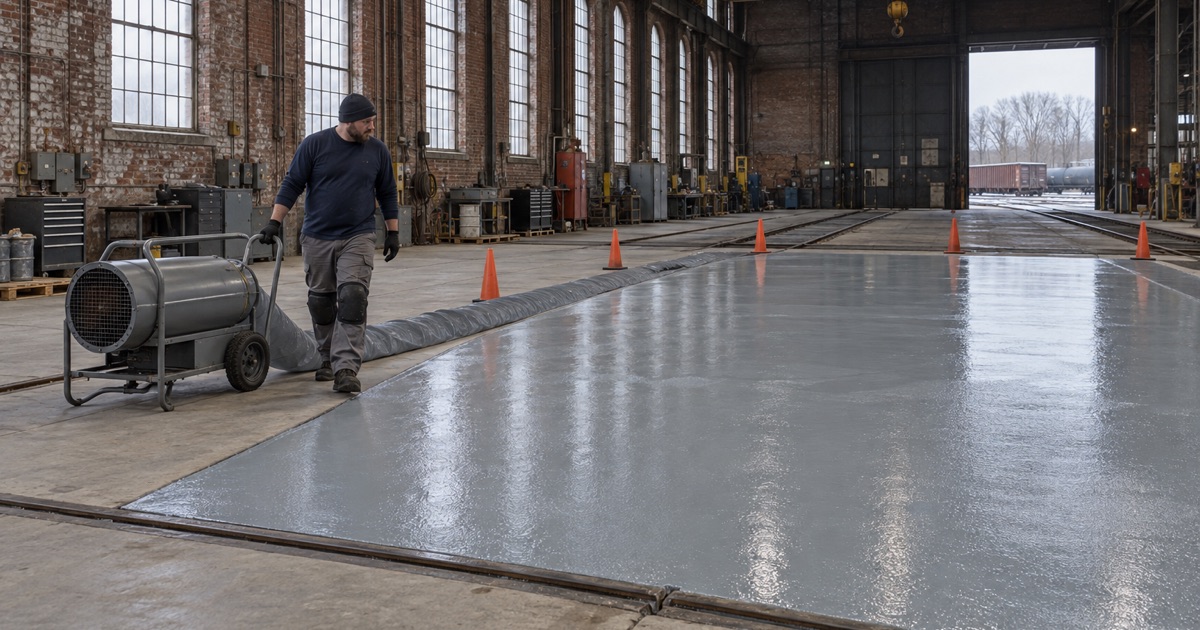
Electric warm air blowers meet those limits without adding water vapor to the room. Their limit is capacity: warming a very large volume to 50 degrees and holding it there through the cure takes serious electrical service, which is why the heat question comes up at the site walk, not the day before.
Staging Bays and Phasing Around the Work
Shops, plants and warehouses rarely stop for a floor. We phase large floors into bays sized to what the heat can hold, with overnight and weekend windows when a line or a repair schedule cannot pause. Each bay is ground, tested, coated and protected as its own unit, so a heating problem in one bay never spreads across the rest of the floor.
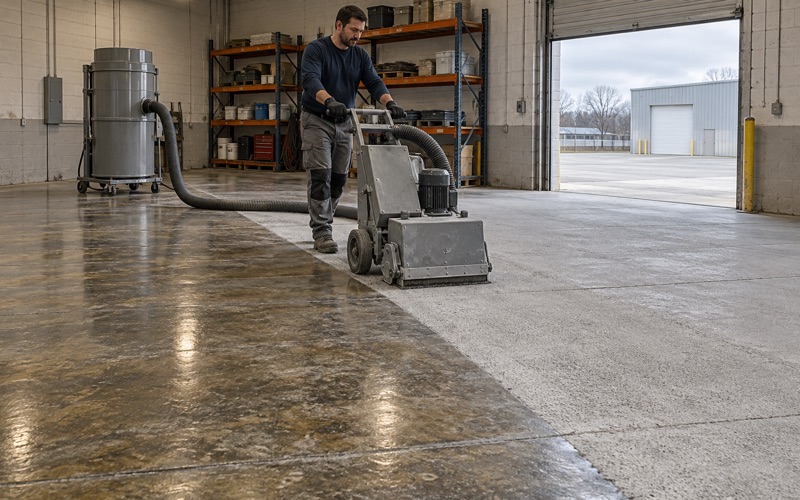
Grinding dust is captured at the machine with a vacuum rather than washed toward a floor drain. The broadcast and topcoat behind a slip-resistant texture, such as quartz aggregate locked in under a 100% solids epoxy or polyaspartic topcoat, are written into the proposal so the finished floor can be checked against it.
Smaller Floors Around Silvis
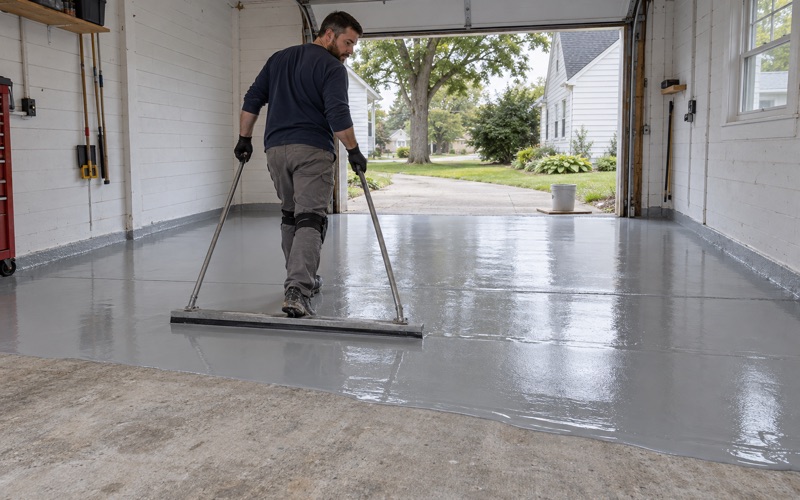
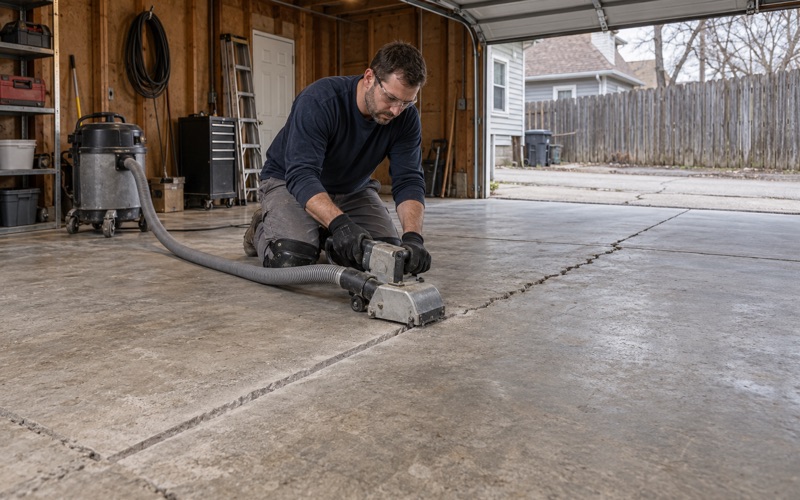
Most floors we coat in Silvis are not shop buildings. The city’s homes are 58 percent owner-occupied, and nearly a quarter of its housing units were built in the 1960s, so we see plenty of garages with older slabs. The heating rule holds there too: an unheated garage in winter waits for the slab to warm, and we will not run a propane heater to rush a cure.
Garage systems we specify for Silvis homes are chosen to stand up to the brine and rock salt that ride in on tires all winter. A floor coating is never sold as waterproofing or radon work, and we put that in writing next to what the warranty leaves out, with moisture named first.
- 20+ Years on Concrete Floors
- Moisture Tested Before Pricing
- Diamond Ground, Never Acid Etched